


 QuotesYatra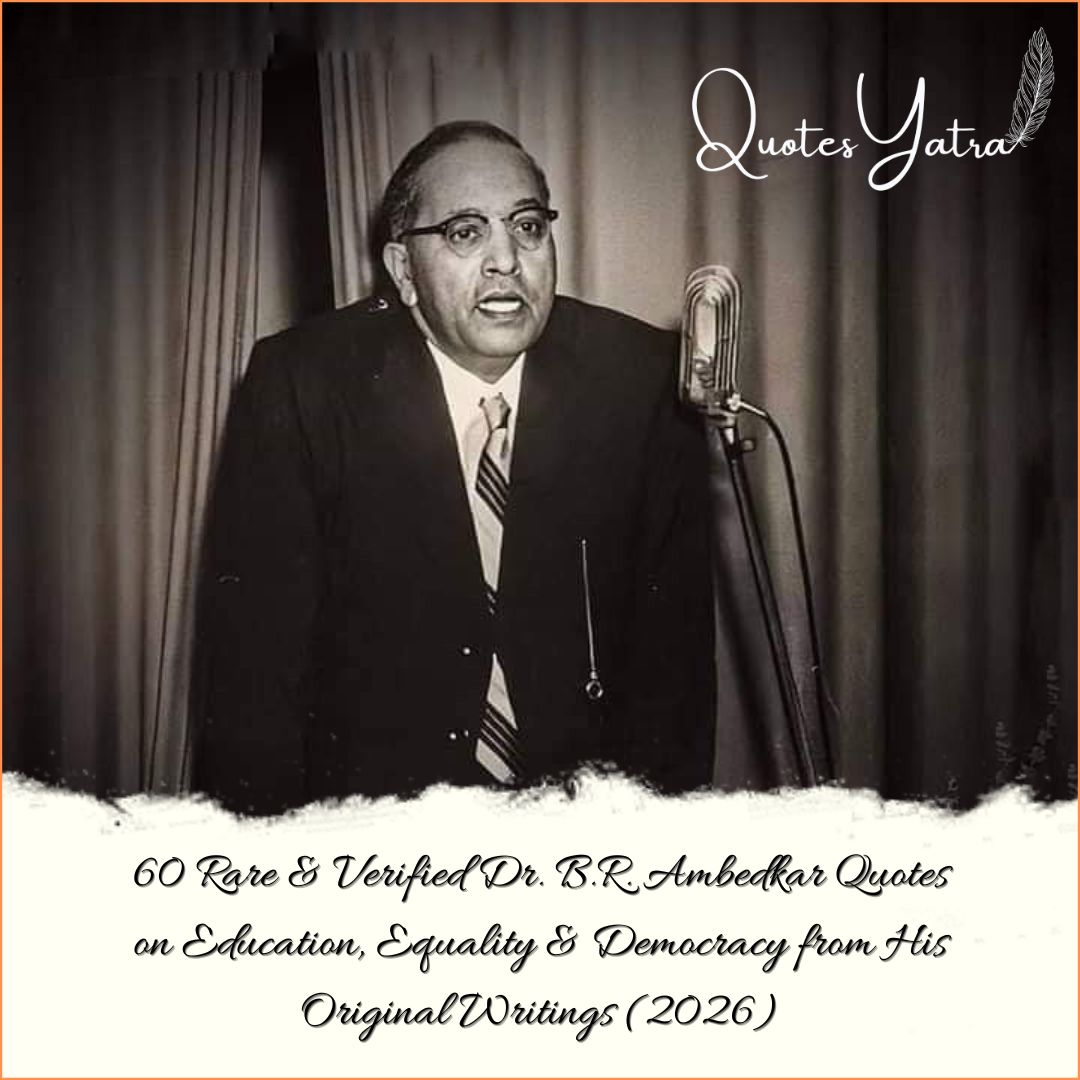
For decades, the internet has circulated the same handful of summarized and, often paraphrased, Dr. B.R. Ambedkar quotes. While those brief slogans hold power, they only scratch the surface of a man who was arguably the greatest intellectual giant of modern history. Dr. Ambedkar was not just a politician; he was a sociologist, an economist, a legal luminary, and a philosopher who carefully built the foundations of a just society through rigorous writing, debate, and lived experience.
As we commemorate the 135th Ambedkar Jayanti in 2026, it is time to look past the social media captions and return to his actual texts. Whether you are a researcher, a journalist, or a reader seeking profound historical truth, we have bypassed the internet rumors and gone straight to the source.
Here is QuotesYatra’s exclusive collection of 60 rare, rigorously verified, and unedited quotes pulled directly from Dr. Babasaheb Ambedkar: Writings and Speeches, his published books, and his official Constituent Assembly debates.
In a world filled with noise, misinformation, and blind admiration, Babasaheb’s words demand something more from us—they ask us to think, to question, and to act. These quotes are not just meant to be read; they are meant to be understood, felt, and lived.
⏱️ In a Rush? The 3 Absolute Best Quotes from This Article
If you only have one minute to spare, here is the ultimate distillation of Dr. Babasaheb Ambedkar’s brilliance. Out of the entire QuotesYatra collection below, these three stand out as the absolute best—capturing his vision for society, his mastery of the mind, and his blueprint for action.
1. The Best Quote on True Equality
“A just society is that society in which ascending sense of reverence and descending sense of contempt is dissolved into the creation of a compassionate society.”
- Why it’s the best: It doesn’t just attack the problem; it provides the perfect solution. It beautifully redefines equality as replacing a ladder of strict hierarchy with a circle of mutual compassion.
2. The Best Quote on Mental Power
“Since it is only by the mind’s authority that the body either acts or ceases to act, therefore to control the thought is alone befitting.”
- Why it’s the best: It strips away all external noise and reminds the reader that the ultimate form of rebellion and power begins entirely with mastering your own internal thoughts.
3. The Best Quote on Taking Action
“Lost rights are never regained by appeals to the conscience of the usurpers, but by relentless struggle.”
- Why it’s the best: It is a fierce, unapologetic reality check. It teaches that you cannot politely ask an oppressor to hand back your rights; true justice requires organizing and fighting relentlessly for it.
Why These Quotes Matter Today
It is easy to look at Dr. B.R. Ambedkar solely as a historical figure—a statue in a town square or a portrait on a classroom wall. However, reducing him to just the “Father of the Indian Constitution” ignores the raw, radical, and intensely practical nature of his philosophy.
For today’s students, activists, and future leaders, these quotes are not just words from the past; they are an active survival guide for the present. Here is why his highly verified, unedited writings are more critical now than ever:
- The Antidote to Blind Hero-Worship: In an era of intense political polarization and celebrity culture, Babasaheb’s fierce warnings against “Bhakti in politics” remind the youth to demand accountability rather than blindly idolizing leaders. He teaches that intellectual independence is the cornerstone of true democracy.
- Defining True Freedom: We often mistake physical or political independence for total freedom. Ambedkar forces us to realize that as long as social tyranny, caste discrimination, and gender inequality exist, true freedom remains out of reach. His words validate the ongoing struggles of marginalized communities today.
- A Blueprint for Modern Activism: Modern social media activism can sometimes feel disconnected from real-world results. Babasaheb’s insistence on “constitutional methods” and his warning that rights are meaningless without “legal remedies” teach young activists how to channel their anger into structured, lasting legislative change.
- The Demand for Intellectual Integrity: In an age of misinformation and fake quotes, Ambedkar’s relentless pursuit of truth stands out. As he stated, the intellectual class carries the destiny of the nation. Reading his actual, unedited academic work challenges students to elevate their own standard of research and critical thinking.
Dr. Ambedkar did not just write laws; he diagnosed the psychological and social flaws of society with absolute precision. By reading his authentic words, today’s youth are armed with the exact arguments needed to continue the fight for a truly equal, rational, and just world.
Quotes from Annihilation of Caste (1936)
This section reflects Ambedkar’s boldest and most revolutionary critique of caste and religious orthodoxy. It exposes deep-rooted social inequalities while offering a clear intellectual path toward true social reform.
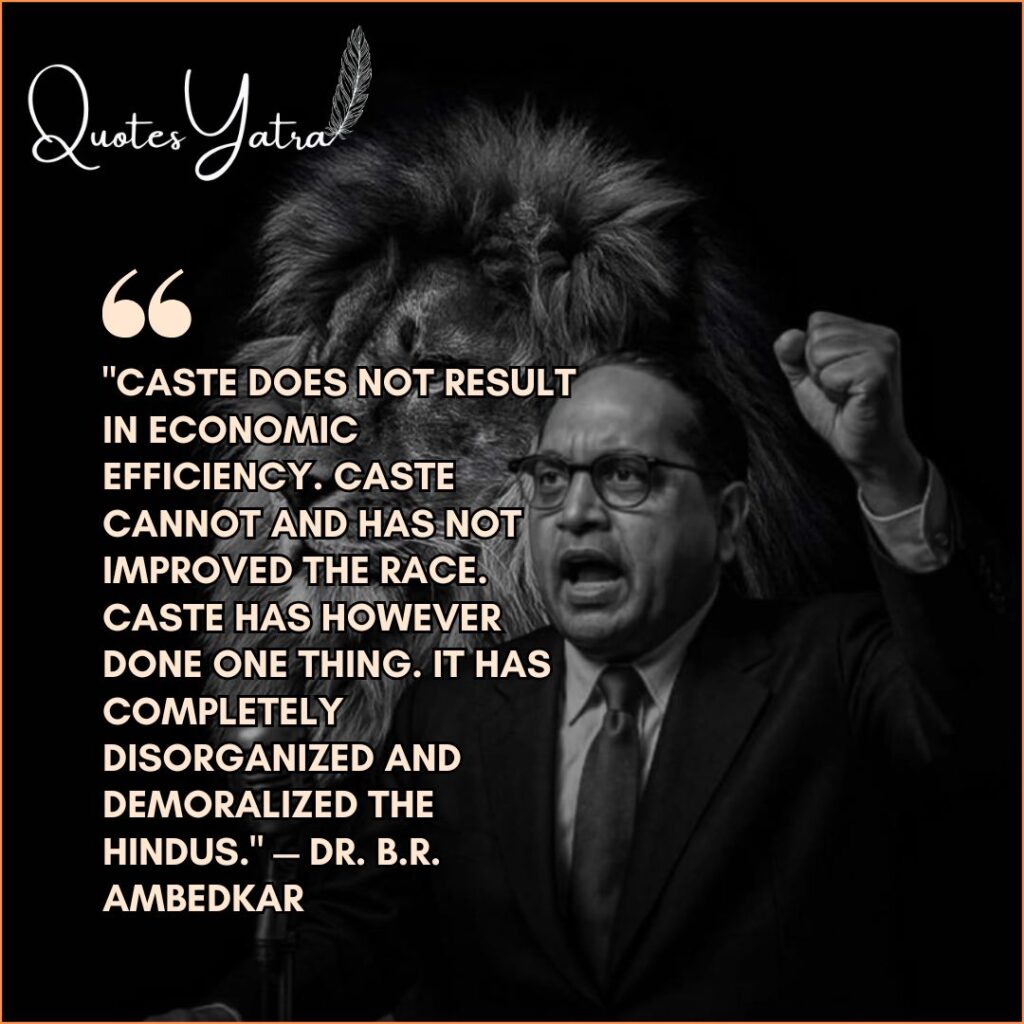
- “Caste does not result in economic efficiency. Caste cannot and has not improved the race. Caste has however done one thing. It has completely disorganized and demoralized the Hindus.”
- Why it works: This directly attacks the traditional arguments that tried to justify the caste system as a “division of labor.” It is a cold, academic dismantling of a societal myth.
- Best for: Economic and historical analyses of the Indian labor system.
- “What is required is to free the minds of the Hindus from the thraldom of the Shastras. Their acts of conservatism and discrimination are the result of their belief in their religion.”
- Why it works: It addresses the root cause of inequality rather than just the symptoms, making it a critical quote for understanding his later shift toward Buddhism.
- Best for: Academic discussions on the intersection of religion and social justice.
- “A just society is that society in which ascending sense of reverence and descending sense of contempt is dissolved into the creation of a compassionate society.”
- Why it works: This beautifully defines the ultimate goal of his life’s work. It replaces systemic hierarchy with mutual compassion, creating an inspiring vision of true equality.
- Best for: Human rights day posts, social justice essays, and philosophical reflections.
- “You must not only discard the Shastras, you must deny their authority, as did Buddha and Nanak.”
- Why it works: This is an unapologetic call to intellectual rebellion. It invokes the legacy of other great reformers to validate the necessity of challenging oppressive traditional texts.
- Best for: Critical thinking forums, religious studies essays, and historical debate quotes.
- “Religion must mainly be a matter of principles only. It cannot be a matter of rules. The moment it degenerates into rules it ceases to be religion, as it kills the responsibility which is the essence of a truly religious act.”
- Why it works: A sharp, liberating distinction between rigid dogma and true spiritual morality. It appeals perfectly to a generation exploring spirituality while actively rejecting discriminatory rules.
- Best for: Inter-faith dialogues, daily affirmation graphics, and self-reflection posts.
- “History bears out the proposition that political revolutions have always been preceded by social and religious revolutions.”
- Why it works: This is a heavy-hitting historical observation. It proves to the reader that you cannot just change a government and expect progress; you must first change the culture.
- Best for: Political science essays, history assignments, and deep-dive editorial captions.
- “The emancipation of the mind and the soul is a necessary preliminary for the political expansion of the people.”
- Why it works: It connects personal, intellectual freedom directly to national power. It is an incredibly inspiring quote for students, validating that their academic growth is the first step toward national progress.
- Best for: Study motivation, graduation speeches, and educational seminars.
- “A Hindu’s public is his caste. His responsibility is only to his caste. His loyalty is restricted only to his caste. Virtue has become caste-ridden, and morality has become caste-bound.”
- Why it works: A sharp, devastating critique of societal division. It forces the reader to confront how systemic divisions destroy genuine community and public responsibility.
- Best for: Sociology papers, civil rights awareness posts, and critical social commentary.
- “People are not wrong in observing Caste. In my view, what is wrong is their religion, which has inculcated this notion of Caste.”
- Why it works: This shows his profound intellectual maturity. Rather than attacking individuals, he attacks the ideology and the texts that programmed them. It is a masterclass in separating the system from the person.
- Best for: Philosophical discussions, inter-faith dialogues, and academic thesis statements.
- “Make every man and woman free from the thraldom of the Shastras, cleanse their minds of the pernicious notions founded on the Shastras, and he or she will inter-dine and inter-marry.”
- Why it works: It is an unapologetic, radical call for intellectual cleansing. It provides a direct, actionable solution (changing the mindset) to achieve ultimate social unity (inter-marriage and dining).
- Best for: Cultural reform debates, progressive youth forums, and deep-thought academic threads.
Quotes from The Buddha and His Dhamma (1957)
These quotes reveal Ambedkar’s final philosophical vision rooted in reason, morality, and human dignity. They emphasize practical spirituality and encourage transforming the world through ethical living.
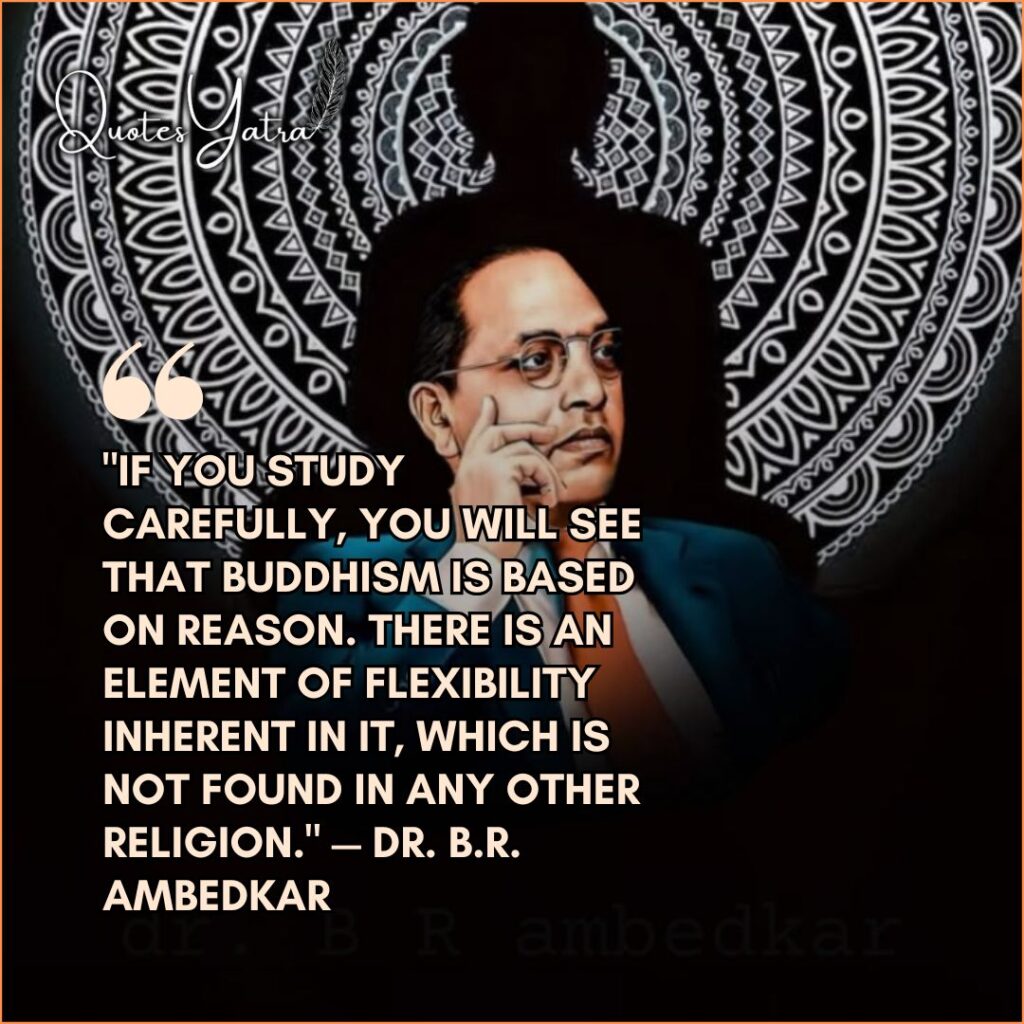
- “If you study carefully, you will see that Buddhism is based on reason. There is an element of flexibility inherent in it, which is not found in any other religion.”
- Why it works: This perfectly bridges spirituality and science. It gives modern, scientifically-minded students a framework for understanding religion without having to sacrifice their logical reasoning.
- Best for: University thesis introductions, comparative religion studies, and analytical essays.
- “He did not tell people that their aim in life should be to reach some imaginary heaven. The kingdom of righteousness lies on earth and is to be reached by man by his own righteous conduct.”
- Why it works: This perfectly captures Ambedkar’s pragmatic, human-centric approach to spirituality. It rejects superstition in favor of tangible, earthly morality.
- Best for: Philosophical discussions, humanist forums, and spiritual reflections.
- “The teachings of Buddha are eternal, but even then Buddha did not proclaim them to be infallible.”
- Why it works: This is a phenomenal quote for intellectual humility. It shows that even the greatest spiritual teachings must remain open to questioning, setting a standard that no text is above human reason.
- Best for: Essays on religious philosophy, critical thinking seminars, and academic debates.
- “What is necessary is not escape from the world. What is necessary is to change the world and to make it better.”
- Why it works: It directly attacks the traditional ascetic idea that a holy person must run away from society. It tells the youth that true morality is found in staying and fighting to improve the world they live in.
- Best for: Social activism campaigns, volunteer drive posters, and youth leadership summits.
- “Since it is only by the mind’s authority that the body either acts or ceases to act, therefore to control the thought is alone befitting.”
- Why it works: This is the ultimate “mindset” quote. It strips away complex rituals and tells the reader that true power begins entirely with mastering one’s own internal thoughts and impulses.
- Best for: Daily motivation graphics, mindfulness and meditation groups, and self-improvement blogs.
- “The religion of Buddha has the capacity to change according to times, a quality which no other religion can claim to have.”
- Why it works: For a generation that often views tradition as stagnant and outdated, this quote offers a dynamic, evolving view of morality that can adapt to the modern era.
- Best for: Editorials on modernizing society, youth forums, and progressive religious discussions.
- “The slayer gets a slayer in his turn; the conqueror gets one who conquers him; a man who despoils is despoiled in his turn.”
- Why it works: A fierce, poetic reminder of consequence and the cyclical nature of violence and oppression. It serves as a stark warning to those who abuse power.
- Best for: Historical analyses, political science essays, and deep-thought Instagram threads.
- “The purpose of Religion is to explain the origin of the world. The purpose of Dhamma is to reconstruct the world.” — (Source: Book IV, Part 1, Section 1)
- Why it works: This is an exact, razor-sharp distinction between traditional faith and active social reform. It is perfect for readers looking for the undeniable, word-for-word truth of his philosophy.
- Best for: Philosophical essays, religious studies, and high-level academic debates.
- “Morality is Dhamma and Dhamma is Morality. In other words, in Dhamma morality takes the place of God although there is no God in Dhamma.” — (Source: Book IV, Part 1, Section 2)
- Why it works: This is his literal, unfiltered explanation of secular ethics. It is a brilliant, heavy-hitting quote for students exploring humanist and non-theistic approaches to living a good life.
- Best for: Ethics and philosophy lectures, secular humanism forums, and deep-thought posts.
- “Religion, it is said, is personal and one must keep it to oneself. One must not let it play its part in public life. Contrary to this, Dhamma is social. It is fundamentally and essentially so.” — (Source: Book IV, Part 1, Section 1)
- Why it works: This is the actual, uncut text of the concept I summarized earlier. It establishes exactly how he viewed the role of ethics in the public sphere versus private worship.
- Best for: Civic duty awareness, law and morality essays, and sociological discussions.
- “What the Buddha calls Dhamma differs fundamentally from what is called Religion.” — (Source: Book IV, Part 1, Section 1)
- Why it works: A short, powerful, verbatim opening statement. It immediately challenges the reader’s preconceived notions and invites them to read further.
- Best for: Introductory paragraphs in academic papers, aesthetic text-overlays, and debate hooks.
- Why it works: A short, powerful, verbatim opening statement. It immediately challenges the reader’s preconceived notions and invites them to read further.
Quotes from Constituent Assembly Debates & Official Memorandums
Here, Ambedkar speaks as a constitutional architect shaping a nation’s future. These lines highlight democracy, individual rights, and the responsibilities required to build a truly united and just India.
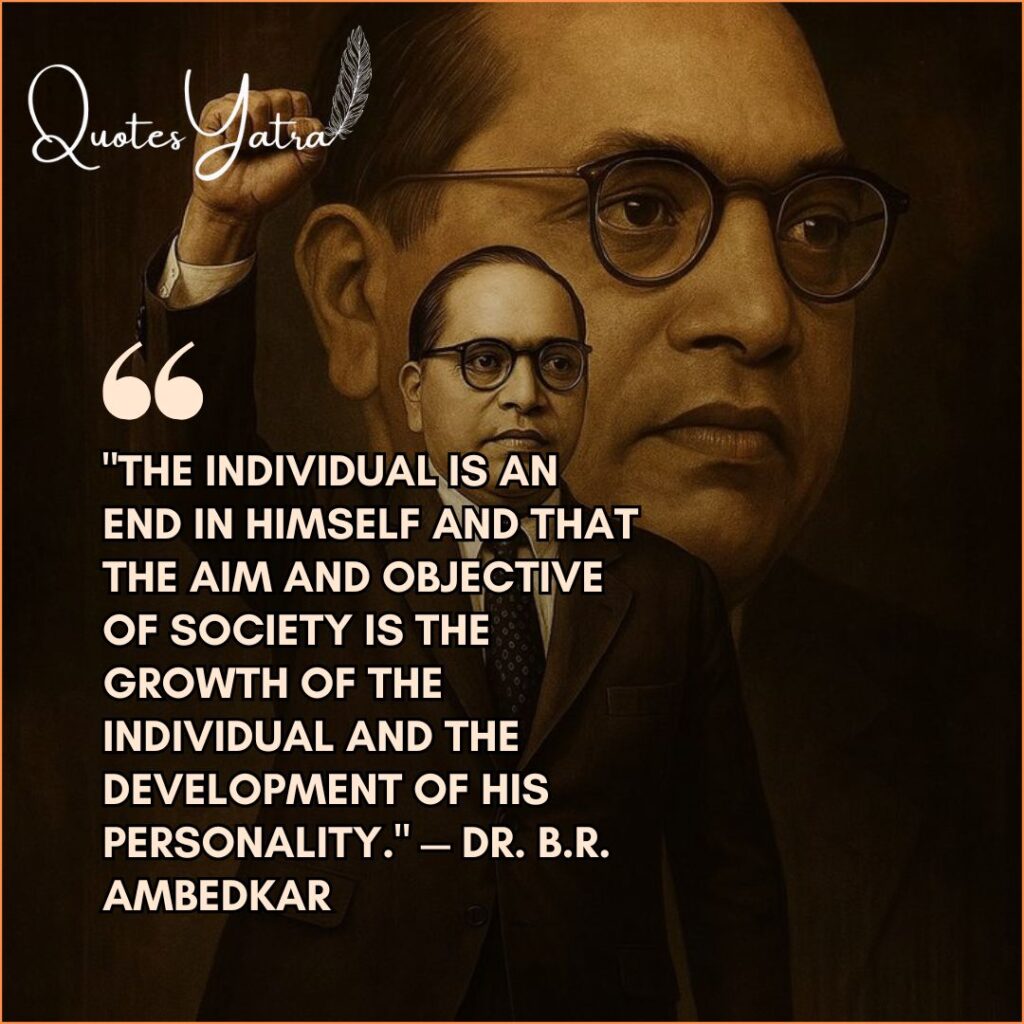
- “The individual is an end in himself and that the aim and objective of society is the growth of the individual and the development of his personality.” — (Source: States and Minorities Memorandum, 1947)
- Why it works: This is the bedrock of fundamental rights. It declares that the state exists to serve the citizen, not the other way around.
- Best for: Constitutional law essays, human rights day posts, and legal studies.
- “I am of opinion that in believing that we are a nation, we are cherishing a great delusion. How can people divided into several thousands of castes be a nation?” — (Source: Constituent Assembly Debates, November 25, 1949)
- Why it works: A bold, uncomfortable, and necessary historical truth. It forces the reader to confront the reality that true patriotism isn’t just about borders, but about tearing down the internal walls that divide the citizens.
- Best for: Deep-dive editorial captions, sociology assignments, and discussions on national integration.
- “The castes are anti-national. In the first place because they bring about separation in social life. They are anti-national also because they generate jealousy and antipathy between caste and caste.” — (Source: Constituent Assembly Debates, November 25, 1949)
- Why it works: This entirely redefines the word “anti-national” for the modern era. It arms students with the ultimate, historically verified argument that social discrimination is the greatest threat to national security and unity.
- Best for: Political science debates, social justice graphics, and youth empowerment seminars.
- “These down-trodden classes are tired of being governed. They are impatient to govern themselves. This urge for self-realization in the down-trodden classes must not be allowed to devolve into a class struggle or class war.” — (Source: Constituent Assembly Debates, November 25, 1949)
- Why it works: This shows his immense foresight and responsibility as a statesman. He acknowledges the valid anger of the marginalized but urges that this energy be channeled into leadership and governance, not destructive warfare.
- Best for: Leadership training for marginalized youth, civic duty awareness, and historical analyses of the Dalit movement.
- “I know to-day we are divided politically, socially and economically; we are a group of warring camps and I may go even to the extent of confessing that I am probably one of the leaders of such a camp. But, Sir, with all this, I am quite convinced that given time and circumstances nothing in the world will prevent this country from becoming one.” — (Source: Constituent Assembly Debates, December 17, 1946)
- Why it works: This is an incredibly vulnerable and honest moment from Babasaheb. He openly acknowledges the deep divisions and his own role in the political battles of the time, yet ends with a fiercely optimistic vision of ultimate national unity.
- Best for: Essays on national integration, debate club introductions, and profound Republic Day posts.
- “What is the village but a sink of localism, a den of ignorance, narrow-mindedness and communalism? I am glad that the Draft Constitution has discarded the village and adopted the individual as its unit.” — (Source: Constituent Assembly Debates, November 4, 1948)
- Why it works: This is one of his most fiercely debated and radically progressive statements. While others romanticized the Indian village, Ambedkar called out the brutal reality of rural caste oppression, explaining why the Constitution must protect the individual first and foremost.
- Best for: Sociology assignments, political science debates, and deep-dive historical analysis on rural vs. urban rights.
- “To diehards who have developed a kind of fanaticism against minority protection I would like to say two things. One is that minorities are an explosive force which, if it erupts, can blow up the whole fabric of the State.” — (Source: Constituent Assembly Debates, November 4, 1948)
- Why it works: A stern, pragmatic warning to the majority. He frames the protection of minority rights not just as a moral charity, but as an absolute necessity for the survival and stability of the entire nation.
- Best for: Human rights essays, legal studies, and editorials on constitutional protections.
- “There is nothing to be ashamed of in borrowing. It involves no plagiarism. Nobody holds any patent rights in the fundamental ideas of a Constitution.” — (Source: Constituent Assembly Debates, November 4, 1948)
- Why it works: Ambedkar faced criticism for studying and adapting laws from America, Britain, and Ireland to draft India’s Constitution. This brilliant, unapologetic defense teaches students that seeking knowledge globally is a strength, not a weakness.
- Best for: Law school motivation, academic research methodology quotes, and Constitution Day features.
- “This anxiety is deepened by the realization of the fact that in addition to our old enemies in the form of castes and creeds we are going to have many political parties with diverse and opposing political creeds. Will Indians place the country above their creed or will they place creed above country? I do not know..” — (Source: Constituent Assembly Debates, November 25, 1949)
- Why it works: A haunting, open-ended question left for the future generations to answer. By refusing to give a guaranteed happy ending, he places the burden of India’s success directly on the shoulders of today’s youth.
- Best for: Youth leadership seminars, civic responsibility captions, and deep-thought political commentary.
- “If I was asked to name any particular article in this Constitution as the most important—an article without which this Constitution would be a nullity—I could not refer to any other article except this one. It is the very soul of the Constitution and the very heart of it.” — (Source: Constituent Assembly Debates, December 9, 1948)
- Why it works: Spoken in defense of Article 32 (Right to Constitutional Remedies), this quote brilliantly elevates the right to demand justice above all other rights. It teaches students that fundamental rights are completely meaningless on paper unless citizens have a direct, legal mechanism to enforce them in court.
- Best for: Law school seminars, human rights campaigns, and Constitution Day editorials on judicial power.
Quotes from Who Were the Shudras? & Other Books
This section explores Ambedkar’s historical and sociological analysis of caste and inequality. It challenges traditional narratives and reveals how systemic injustice evolved over time.
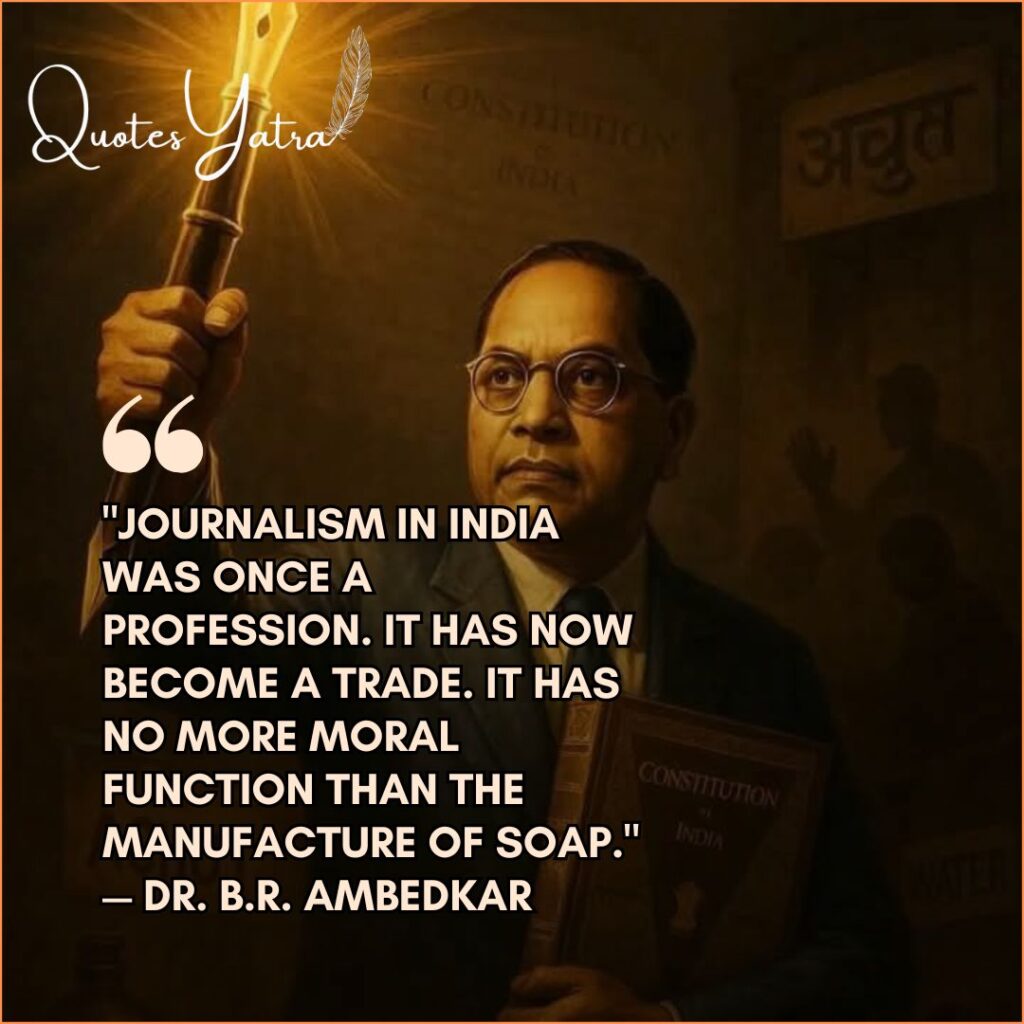
- “Journalism in India was once a profession. It has now become a trade. It has no more moral function than the manufacture of soap.” — (Source: ‘Ranade, Gandhi and Jinnah’, 1943)
- Why it works: A devastatingly sharp and highly verified critique of the media. This is an incredibly popular quote among mass communication students because it challenges them to restore ethics to their future profession.
- Best for: Media studies lectures, journalism day posts, and essays on the ethics of mass communication.
- “A State may rest on force. But a Nation must rest on a sentiment.” — (Source: ‘Pakistan or the Partition of India’, 1940)
- Why it works: This perfectly separates the concept of a government (State) from the people (Nation). It teaches students that while the police and army can maintain a government, only the shared emotional bond of the citizens can keep the actual country alive.
- Best for: Political science essays, Republic Day captions, and discussions on national integration.
- “A democratic government can remain democratic only if it is worked by two parties—a party in power and a party in opposition.” — (Source: ‘Thoughts on Linguistic States’, 1955)
- Why it works: A brilliant, concise lesson in political science. It validates the necessity of dissent and opposition, showing young people that questioning the government is not anti-national; it is actually the mechanism that keeps democracy functioning.
- Best for: Student election campaigns, civic duty awareness, and political science study groups.
- “Rights are real only if they are accompanied by remedies. It is no use giving rights if the aggrieved person has no legal remedy to which he can resort when his rights are invaded.” — (Source: ‘States and Minorities’, 1947)
- Why it works: A flawlessly logical, verbatim legal truth. It cuts through the fluff of political promises, stating that a right on a piece of paper is useless unless a citizen has the actual power and access to defend it in court.
- Best for: Human rights day features, legal studies essays, and social justice editorials.
- “Hero-worship in the sense of expressing our unbounded admiration is one thing. To obey the hero is a totally different kind of heroworship. There is nothing wrong in the former while the latter is no doubt a most pernicious thing” — (Source: ‘Ranade, Gandhi and Jinnah’, 1943)
- Why it works: He perfectly dissects the danger of celebrity and political culture. It tells students that it is fine to admire a leader, but the moment you stop questioning them and begin blindly obeying them, you destroy your own intellectual freedom.
- Best for: Political commentary, leadership workshops, and critical thinking quotes.
- “Caste is a local problem, but one capable of much wider mischief, for as long as caste in India does exist, Hindus will hardly intermarry or have any social intercourse with outsiders; and if Hindus migrate to other regions on earth, Indian caste would become a world problem.” — (Source: ‘Castes in India: Their Mechanism, Genesis and Development’, 1916)
- Why it works: This is an unbelievably visionary quote from a paper he wrote at Columbia University when he was just a young student himself. It predicted exactly what is happening globally today regarding caste discrimination in international tech companies and universities.
- Best for: Global diaspora studies, international relations essays, and modern tech-industry social commentary.
- “The history of India is nothing but a history of a mortal conflict between Buddhism and Brahminism.” — (Source: ‘Who Were the Shudras?’, Preface)
- Why it works: This is one of his boldest and most frequently cited historical conclusions. It frames Indian history not as a series of foreign invasions, but as a deep ideological battle between equality (Buddhism) and hierarchy (Brahminism).
- Best for: History students, essays on the evolution of Indian society, and deep-dive historical debates.
- “The system of pains and penalties was no doubt originally devised by the Brahmins to deal with the Shudras of the Indo-Aryan society, who have ceased to exist as a distinct, separate, identifiable community.” — (Source: ‘Who Were the Shudras?’, Preface)
- Why it works: This quote directly challenges the notion that the modern caste system is a continuation of ancient demographics. It highlights his argument that the legal system of oppression was maintained even as the original groups changed over millennia.
- Best for: Sociological research papers, historical analysis posts, and discussions on the origins of systemic inequality.
- “If the Hindu law-givers had enough historical sense to realise that the original Shudras were different from the present-day low-class people, this tragedy—this massacre of the innocents—would have been avoided.” — (Source: ‘Who Were the Shudras?’, Preface)
- Why it works: This is a devastating critique of how ancient laws are blindly applied to modern people. It underscores his belief that the rigid adherence to ancient texts without historical context results in continuous human suffering.
- Best for: Legal history essays, critical examinations of ancient texts, and editorial pieces on social justice.
- “I take refuge in the belief that even the fool has a duty to perform, namely, to do his bit if the angel has gone to sleep or is unwilling to proclaim the truth. This is my justification for entering the prohibited field.” — (Source: ‘Who Were the Shudras?’, Preface)
- Why it works: This is an incredibly humble yet determined statement. It shows his resolve to speak the truth about history, even when established scholars (“angels”) chose to remain silent. It’s a powerful motivation for intellectual bravery.
- Best for: Graduation speeches, motivational posts for researchers, and captions about standing up for truth.
- “But if a person is an honest critic, howsoever cautious, however conservative he may be, provided that he has an open mind and a readiness to accept facts, I do not despair of converting him to my view.” — (Source: ‘Who Were the Shudras?’, Preface)
- Why it works: This perfectly captures his faith in rational debate and the power of evidence. It shows that he welcomed criticism, provided it was based on an open mind and a willingness to engage with facts rather than dogma.
- Best for: Debate club rules, academic discourse guidelines, and posts promoting open-mindedness.
Quotes from Speeches & Conferences
These powerful words come directly from Ambedkar’s public addresses to the people. They are filled with urgency, motivation, and practical guidance for social change and personal empowerment.
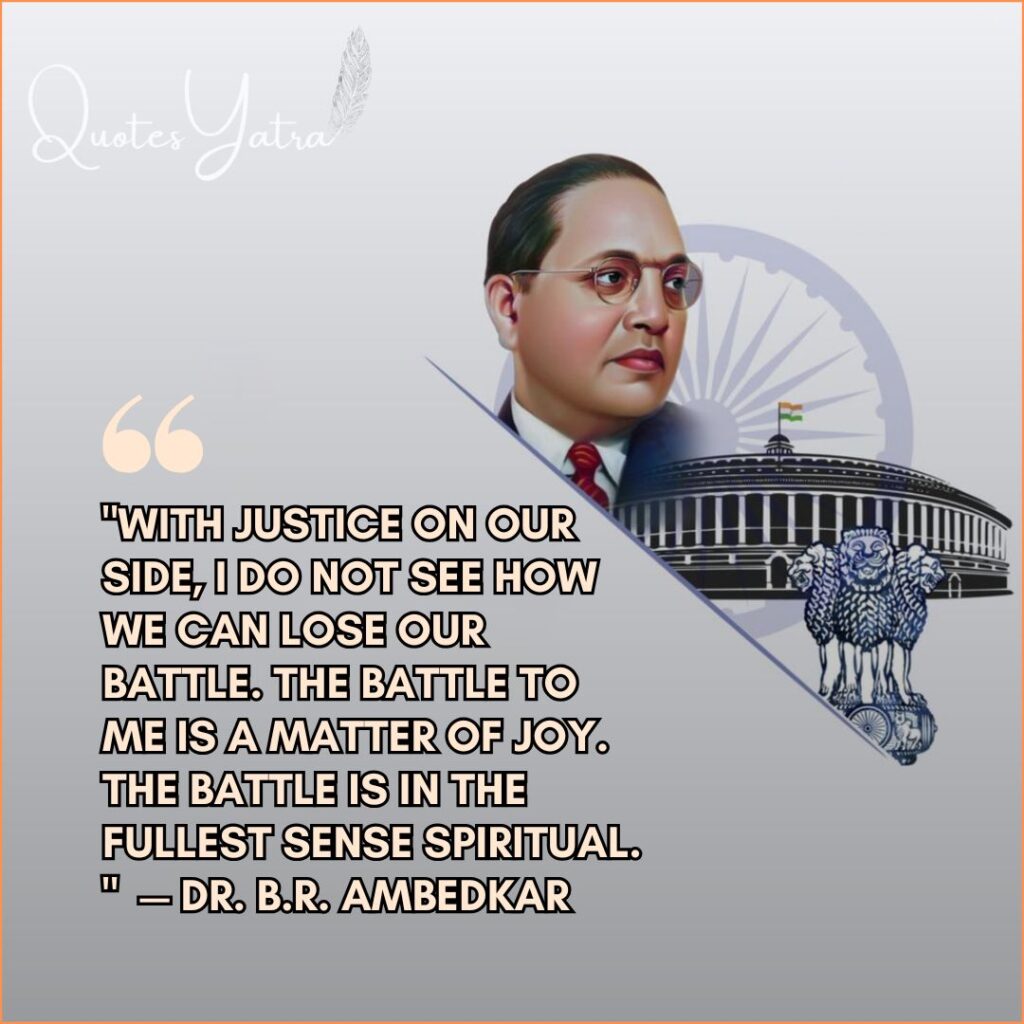
- “With justice on our side, I do not see how we can lose our battle. The battle to me is a matter of joy. The battle is in the fullest sense spiritual. ” — (Source: All-India Depressed Classes Conference, Nagpur, July 1942)
- Why it works: Many students view the fight for equality as exhausting. Here, Ambedkar reframes the struggle as a source of joy and spiritual fulfillment. It is a tremendously uplifting quote that replaces activist burnout with deep, energetic purpose.
- Best for: Youth leadership motivation, student council campaigns, and morning affirmation posts.
- “Lost rights are never regained by appeals to the conscience of the usurpers, but by relentless struggle.” — (Source: G.I.P. Railway Depressed Class Workmen’s Conference, Manmad, February 1938)
- Why it works: A fierce, unapologetic reality check. It teaches young leaders that they cannot simply politely ask the oppressors to give up their power; they must organize, fight, and claim their rights through sustained, relentless effort.
- Best for: Debate competitions, labor day posts, and youth activism seminars.
- “Learn to be clean. Keep from vices. Give education to your children. Instill ambition into them. Inculcate in their minds that they are destined to be great. Remove from them all inferiority complex. Do not be in a hurry to marry.” — (Source: Address to the All-India Depressed Classes Women’s Conference, July 20, 1942)
- Why it works: Spoken directly to a crowd of marginalized mothers, this is one of his most fiery and practical directives. It targets the psychological damage of systemic oppression (“inferiority complex”) and offers a clear, actionable cure: education and relentless ambition.
- Best for: Parent-student motivation, educational empowerment campaigns, and Teachers’ Day or Mother’s Day features.
- “By Brahmanism I do not mean the power, privileges and interests of the Brahmins as a community. By Brahmanism I mean the negation of the spirit of Liberty, Equality and Fraternity.” — (Source: G.I.P. Railway Depressed Class Workmen’s Conference, Manmad, February 1938)
- Why it works: This is a crucial historical clarification. It proves that his activism was not a battle against a specific group of people, but a battle against an ideology that denies equality. It is a masterclass in separating systemic critique from personal hatred.
- Best for: Advanced sociology papers, political science debates, and high-level critical thinking forums.
- “With great difficulty I have brought this caravan where it is seen today. Let the caravan march on despite the hurdles that may come in its way. If my lieutenants are not able to take the caravan ahead they should leave it there, but in no circumstances should they allow the caravan to go back.” — (Source: Public Rally in Agra, March 18, 1956)
- Why it works: Delivered just months before his death, this is a haunting, intensely emotional plea to the youth. He passes the torch to the next generation, giving them the ultimate responsibility: you don’t have to fix everything today, but you are strictly forbidden from letting society slide backward.
- Best for: Youth leadership inaugurations, Ambedkar Jayanti closing statements, and powerful Instagram captions.
- “To leave inequality between class and class, between sex and sex, which is the soul of Hindu Society, untouched and to go on passing legislation relating to economic problems is to make a farce of our Constitution and to build a palace on a dung heap.” — (Source: Resignation Statement in Parliament regarding the Hindu Code Bill, September 27, 1951)
- Why it works: This is perhaps the most devastating metaphor he ever used in a speech. By using the exact phrase “palace on a dung heap,” he forces the reader to realize that economic wealth means absolutely nothing if society treats women and marginalized classes like dirt.
- Best for: Women’s rights advocacy, economics papers, and deep-dive editorial captions.
- “We must have a Government in which men in power, knowing where obedience will end and resistance will begin, will not be afraid to amend the social and economic code of life which the dictates of justice and expediency so urgently call for.” — (Source: Plenary Session, First Round Table Conference, London, November 20, 1930)
- Why it works: Spoken directly to the British elite in London, this quote perfectly defines what a fearless, just government looks like. It teaches political science students that a real leader is not afraid to change ancient rules if justice demands it.
- Best for: Political science lectures, leadership quotes, and historical debates on the Round Table Conferences.
- “Why does a human body become deceased? The reason is that as long as the human body is not free from suffering, mind cannot be happy. If a man lacks enthusiasm, either his body or mind is in a deceased condition…. Now what saps the enthusiasm in man? If there is no enthusiasm, life becomes drudgery – a mere burden to be dragged. Nothing can be achieved if there is no enthusiasm. The main reason for this lack of enthusiasm on the part of a man is that an individual looses the hope of getting an opportunity to elevate himself.” — Dr. B.R. Ambedkar
- “A bitter thing cannot be made sweet. The taste of anything can be changed. But poison cannot be changed into nectar.” — Dr. B.R. Ambedkar
- Why it works: A brilliant, sharp metaphor used to describe inherently toxic systems (like caste and inequality). It teaches students that some social systems cannot be “reformed” or sweetened; they must be entirely discarded.
- Best for: Debate club hooks, critical thinking essays, and short, aesthetic quote graphics.
- “Justice has always evoked ideas of equality, of proportion of compensation. Equity signifies equality. Rules and regulations, right and righteousness are concerned with equality in value. If all men are equal, then all men are of the same essence, and the common essence entitles them of the same fundamental rights and equal liberty… In short justice is another name of liberty, equality and fraternity.” — Dr. B.R. Ambedkar
- Why it works: He takes abstract, highly academic legal terms and distills them into a single, undeniable conclusion. It is the perfect, authoritative quote for anyone trying to define what “justice” actually means in a modern context.
- Best for: Law school motivation, human rights essays, and legal studies captions.
Quotes from All India Radio Broadcasts & Interviews
In these reflections, Ambedkar shares his most mature and refined thoughts with a wider audience. They combine philosophy, politics, and human values into clear, thought-provoking insights.
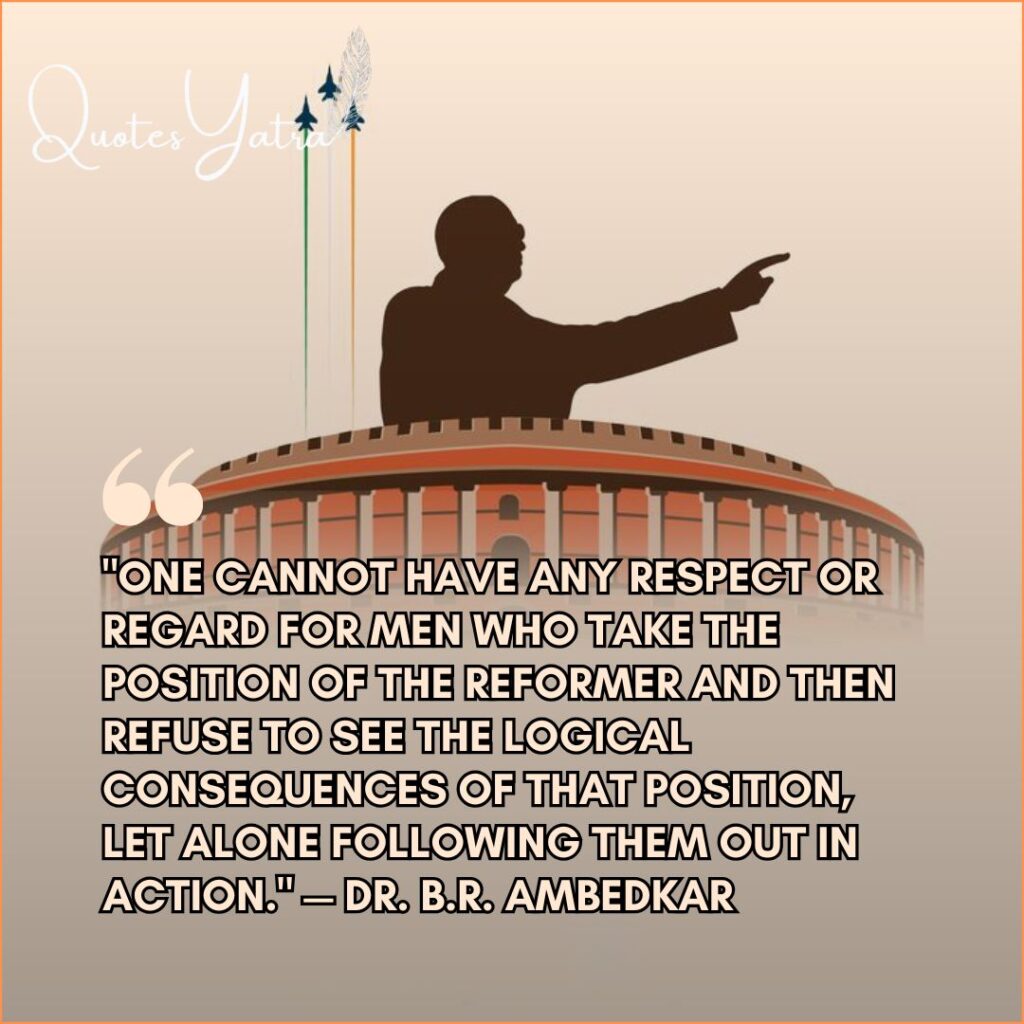
- “One cannot have any respect or regard for men who take the position of the reformer and then refuse to see the logical consequences of that position, let alone following them out in action.”
- Why it works: This is a scathing critique of “armchair activism” or performative sympathy. It warns students that claiming to be a reformer on social media means nothing unless they have the courage to live out those difficult principles in their real lives.
- Best for: Youth leadership campaigns, civic duty awareness, and critical thinking quotes.
- “Positively, my social philosophy may be said to be enshrined in three words: Liberty, Equality and Fraternity. Let no one, however, say that I have borrowed my philosophy from the French Revolution. I have not. My philosophy has roots in religion and not in political science. I have derived them from the teachings of my Master, the Buddha.” — (Source: All India Radio Broadcast, October 3, 1954)
- Why it works: This is a massive historical clarification. Many textbooks falsely claim he just copied the French Revolution. This verbatim quote arms students with the truth: his vision of democracy was rooted deeply in Eastern philosophy and ethics, not just Western politics.
- Best for: History essays, philosophical debates, and Constitution Day editorials.
- Why it works: This is a massive historical clarification. Many textbooks falsely claim he just copied the French Revolution. This verbatim quote arms students with the truth: his vision of democracy was rooted deeply in Eastern philosophy and ethics, not just Western politics.
- “The sovereignty of scriptures of all religions must come to an end if we want to have a united integrated modern India.”
- Why it works: One of his most uncompromising statements on secularism. It plainly states that a modern, unified nation cannot survive if ancient religious texts are allowed to override a democratic, egalitarian Constitution.
- Best for: Inter-faith dialogues, constitutional law essays, and Republic Day editorials.
- “I prefer Buddhism because it gives three principles in combination, which no other religion does. Buddhism teaches prajna (understanding as against superstition and supernaturalism), karuna (love), and samata (equality). This is what man wants for a good and happy life.” — (Source: BBC Broadcast, May 1956)
- Why it works: Delivered just months before his passing, this is arguably the clearest, simplest summary of his entire life’s philosophy. It reduces a massive theological decision into three incredibly relatable, modern concepts: rational understanding, love, and equality.
- Best for: Inter-faith dialogues, daily affirmations, and mental health/spiritual well-being posts.
- “If in any state there is a body of men who possess unlimited political power, those over whom they rule can never be free.For, the one assured result of historical investigation is the lesson that uncontrolled power is invariably poisonous to those who possess it. They are always tempted to impose their canon of good upon others, and in the end, they assume that the good of the community depends upon the continuance of their power. Liberty always demands a limitation of political authority.”
- Why it works: This provides a profound, historically grounded warning against totalitarianism and unchecked power. It perfectly articulates why democratic checks and balances are not just legal formalities, but vital protections for human freedom.
- Best for: Academic essays on political science, law school lectures, and deep-dive editorials on the importance of limiting government power.
- “Nationality is a social feeling. It is a feeling of a corporate sentiment of oneness which makes those who are charged with it feel that they are kith and kin. This national feeling is a double edged feeling. It is at once a feeling of fellowship for one’s own kith and kin and an anti-fellowship feeling for those who are not one’s own kith and kin.”
- Why it works: It completely dismantles the idea that nationality is just about geography or borders. By defining it as a “social feeling” and a sense of “fellowship,” it challenges the youth to build true emotional unity with their fellow citizens, rather than just relying on lines drawn on a map.
- Best for: Sociology assignments, historical essays on nation-building, and debates on nationalism and global unity.
- “Every man must have a philosophy of life, for everyone must have a standard by which to measure his conduct. And philosophy is nothing but a standard by which to measure.”
- Why it works: It takes the intimidating concept of “philosophy” and makes it practical for students. It teaches them that having a core set of values isn’t just for scholars; it is a necessary, everyday tool for making good decisions.
- Best for: Educational motivation, university philosophy club introductions, and self-reflection captions.
- “Once you clear the minds of the people of this misconception and enable them to realise that what they are told is religion is not religion, but that it is really law, you will be in a position to urge its amendment or abolition.”
- Why it works: A masterclass in critical thinking and legal analysis. It teaches students how to deconstruct oppressive traditions by recognizing that many “divine rules” are actually just man-made legal codes designed to maintain power—and because they are man-made, they can be changed.
- Best for: Inter-faith dialogues, law school debates, and critical thinking awareness posts.
- “For myself I shall find as much pleasure in a positive destruction of my own ideology, as in a rational disagreement on a topic, which, notwithstanding many learned disquisitions, is likely to remain controversial forever.”
- Why it works: This is the absolute pinnacle of intellectual maturity. He admits that he would rather be proven wrong through rational, factual debate than blindly hold onto a flawed ideology. It is the perfect quote for cultivating open-mindedness in modern students.
- Best for: Debate club guidelines, university philosophy introductions, and posts promoting rational discourse.
- “There have been many Mahatmas in India whose sole object was to remove Untouchability and to elevate and absorb the depressed classes, but every one of them has failed in his mission. Mahatmas have come, Mahatmas have gone. But the Untouchables have remained as Untouchables.”
- Why it works: This is a devastating, highly academic critique of charismatic leadership. It proves to readers that relying on “saviors” or single great leaders does not dismantle systemic oppression; only hard legal and social reform can do that.
- Best for: Advanced sociology papers, historical debates, and essays on the Dalit movement.
Common Questions About Dr. B.R. Ambedkar’s Quotes & Philosophy (FAQs)
Every quote in this collection has been rigorously verified and pulled directly from original texts, including Dr. Babasaheb Ambedkar: Writings and Speeches (BAWS), Annihilation of Caste, The Buddha and His Dhamma, and the official Constituent Assembly Debates. This QuotesYatra exclusive bypasses internet rumors to provide 100% authentic, unedited historical texts.
One of his most profound definitions of true equality is: “A just society is that society in which ascending sense of reverence and descending sense of contempt is dissolved into the creation of a compassionate society.” This highlights his vision of replacing systemic hierarchy with mutual respect and compassion.
Dr. Ambedkar famously warned that a political constitution is only as good as the society that upholds it. He stated: “Political democracy cannot last unless there lies at the base of it social democracy.” He believed that without liberty, equality, and fraternity practiced in daily social life, political voting rights were not enough to sustain a nation.
For youth and students, Dr. Ambedkar emphasized education, mental freedom, and relentless ambition. A guiding principle he offered was: “Since it is only by the mind’s authority that the body either acts or ceases to act, therefore to control the thought is alone befitting.” He also famously advised the youth to educate themselves, stay away from vices, and rid themselves of any inferiority complex.
Dr. Ambedkar placed the ultimate responsibility on the individual citizen to fight for justice and hold leaders accountable. Believing that blind hero-worship was deeply dangerous to a democracy, he famously warned that to unconditionally obey a hero is “a most pernicious thing.” Rather than just appealing to the conscience of those in power, he urged citizens to rely on relentless struggle.
Conclusion: The Timeless Blueprint for Justice and Humanity
Dr. B.R. Ambedkar’s words are not meant to remain confined within books, speeches, or historical archives. They are living ideas, meant to challenge minds, awaken courage, and guide societies toward something better. His vision was never limited to one era or one nation; it was a universal call for dignity, equality, and fearless thinking.
As you reflect on these rare and verified insights, remember that true respect for his legacy lies not in admiration alone, but in application. Every quote carries a responsibility—to question injustice, to reject blind beliefs, and to stand firmly for what is right, even when it is difficult.
Carry the Legacy Forward:
- Bookmark this page as your definitive, highly-researched historical resource for academic papers, leadership seminars, and debate competitions.
- Share these authentic texts to combat internet misinformation and elevate the standard of social media discourse.
- Keep exploring QuotesYatra for the internet’s most accurate, premium quote collections designed to empower your voice and sharpen your arguments.
The journey toward liberty, equality, and fraternity is still unfinished. Let Babasaheb’s words not just inspire you for a moment, but stay with you as a quiet, enduring compass that shapes how you think, speak, and act in the world.
Related Reads You’ll Love
If these powerful words of Dr. B.R. Ambedkar stirred something within you, there’s so much more waiting to inspire your journey. Dive deeper into wisdom, reflection, and celebration with these handpicked collections crafted to elevate your thoughts and emotions:
- Dr. B.R. Ambedkar Jayanti Quotes, Wishes & Captions: Celebrate Ambedkar Jayanti with meaningful words that honor his legacy while spreading awareness, positivity, and pride.
- Life-Changing Dr. B.R. Ambedkar Quotes: A powerful collection designed especially for young minds, filled with clarity, courage, and the kind of guidance that shapes future leaders.
- Best April Quotes: Step into the beauty of April with quotes that capture renewal, joy, laughter, and the gentle transformation of seasons and life.
Let these reads stay with you a little longer, inspire a little deeper, and remind you that the right words, at the right moment, can truly change everything.

manisha pal
Outstanding english, fabulous I like it