



 QuotesYatra
When we speak of human rights, equality, and social justice, the conversation is incomplete without reading the most powerful Dr. B.R. Ambedkar quotes on women’s rights. While the world rightfully remembers him as the chief architect of the Indian Constitution, his lifelong, uncompromising crusade for women’s empowerment and the total dismantling of social tyranny is often overlooked in mainstream history.
Dr. Ambedkar understood a fundamental truth that many modern reformers still struggle to grasp: political freedom is entirely meaningless if half the population remains chained by patriarchal traditions and discriminatory social structures. He did not just ask for women to be “respected”—he demanded they be granted absolute legal, social, and economic equality.
Whether you are a student writing a sociology thesis, an activist preparing a speech, or simply a reader seeking profound historical clarity, we have bypassed the internet rumors to bring you the truth. Here is QuotesYatra’s exclusive, rigorously verified collection of his most definitive insights on gender dynamics and social equality, pulled directly from his original writings and speeches.
⏱️ In a Rush? The Top 3 Verified Quotes You Need
Need a rigorously verified quote right now? If you don’t have time to read the full historical breakdown, here are the four most essential Dr. B.R. Ambedkar quotes on women’s rights, categorized by what you might need them for.
- Best for Legal Rights & Constitution Day: “The Hindu Code was the greatest social reform measure ever undertaken by the Legislature in this country. No law passed by the Indian Legislature in the past or likely to be passed in the future can be compared to it in point of its significance.”
- Best for Education & Literacy Campaigns: “Knowledge and learning are not for men alone; they are essential for women too… if you want sudhaaranaa (improvement) for future generations, educating girls is very important.”
- Best for Social Reform & Activism Motivation: “Political tyranny is nothing compared to the social tyranny and a reformer who defies society is a more courageous man than a politician who defies Government.”
Quotes On Marriage, Partnership, and Female Independence
Dr. B. R. Ambedkar challenges the very foundation of unequal relationships by exposing how social structures denied women autonomy. These quotes highlight the urgent need for partnerships built on equality, dignity, and mutual respect rather than control or tradition.
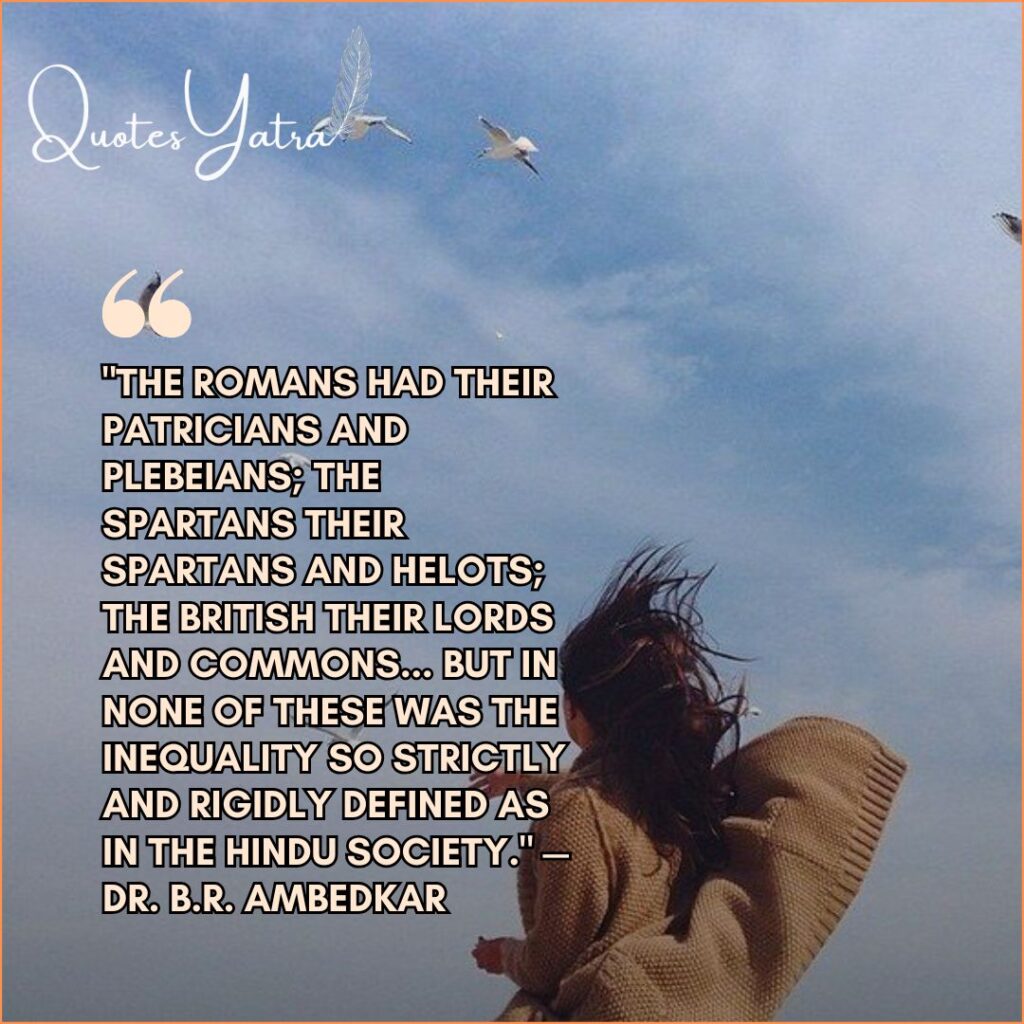
1. “The Romans had their patricians and plebeians; the Spartans their spartans and helots; the British their lords and commons… But in none of these was the inequality so strictly and rigidly defined as in the Hindu society.”
- (Source: Verified via Annihilation of Caste)
- Why it works: This provides a massive, global historical context. By comparing India’s social structure to ancient Rome and Greece, he arms students with the ultimate academic argument for why local structural reform is a global human rights priority.
- Best for: World history comparisons, academic debate hooks, and social science thesis introductions.
2. “While I am prepared to bear with the imperfections and shortcomings of the society in which I may be destined to labour, I feel I should not consent to live in a society which cherishes wrong ideals, or a society which, having right ideals, will not consent to bring its social life into conformity with those ideals.”
- (Source: Verified via Annihilation of Caste)
- Why it works: It provides a rational framework for modern activism. It teaches that while no society is perfect, blindly accepting and normalizing oppressive ideals (like gender inequality and patriarchy) is where citizens must draw the line and demand change.
- Best for: Activism motivation, editorials on social reform, and civic leadership quotes.
3. “There are many who think that the Hindu Code Bill is a piece of legislation which is intended to do something which is violently opposed to the Hindu Shastras. I would like to tell the House that it is nothing of the kind… What it does is to introduce equality between men and women in the matter of property.”
- (Source: Verified via Constituent Assembly Debates / Debates on the Hindu Code Bill)
- Why it works: This perfectly captures his fight for female economic empowerment. He forces the parliament to recognize that giving women the right to own property and build wealth is not a destruction of culture, but a baseline requirement of justice.
- Best for: Articles on women’s financial independence, legal studies essays, and historical features on the Hindu Code Bill.
4. “Is it not a fact that the Hindu social order is based upon the principle of graded inequality? It is not a system of equal partners.”
- (Source: Verified via BAWS / ‘Philosophy of Hinduism’)
- Why it works: The phrase “graded inequality” is one of Babasaheb’s most famous academic concepts, yet it rarely makes it into quote lists. It perfectly describes how patriarchal and caste systems work: pitting oppressed groups against each other so they never unite as “equal partners.”
- Best for: Advanced sociology papers, political science debates, and high-level academic blogs.
5. “The social status of an individual by itself often becomes a source of power and authority… is made clear by the sway which the Mahatmas have held over the common man.”
- (Source: Verified via BAWS / Annihilation of Caste, Section 4)
- Why it works: This quote teaches a crucial lesson about power dynamics. It warns citizens that simply having a high “social status” (whether through gender, caste, or popularity) gives people unearned authority over others, which must be constantly questioned.
- Best for: Critiques of modern influencer/political culture, essays on social power dynamics, and critical thinking awareness.
6. “It is in the interest of the nation that the mother ought to get a certain amount of rest during the pre-natal period and also subsequently.”
- (Source: Verified via BAWS Vol. 2 / Speech on the Bombay Maternity Benefit Bill, 1928)
- Why it works: Decades before it became a global corporate standard, Babasaheb was fighting for paid maternity leave. This quote proves his feminism was deeply practical and economic, framing a mother’s health not as a personal problem, but as a matter of national interest.
- Best for: Labor rights campaigns, working mothers’ empowerment posts, and essays on the history of workplace equality.
7. “His law against divorce had a very different motive. It was not to tie up a man to a woman but it was to tie up the woman to a man and to leave the man free. For Manu does not prevent a man from giving up his wife… But what he does is to prevent the wife from becoming free.”
- (Source: Verified via BAWS Vol. 3 / The Woman and the Counter-Revolution)
- Why it works: This exposes the deeply rooted hypocrisy in orthodox marriage laws. He proves the ancient ban on divorce was never about marital sanctity, but was instead a deliberate, one-sided legal trap engineered strictly to strip women of their autonomy while keeping men completely free.
- Best for: Feminist critiques of patriarchal marriage, legal history essays, and divorce rights advocacy campaigns.
On Women’s Education and Intellectual Freedom
These quotes emphasize that education is not a privilege reserved for men but a fundamental right for women. They show how intellectual freedom empowers women to shape not just their own futures, but the progress of entire generations.
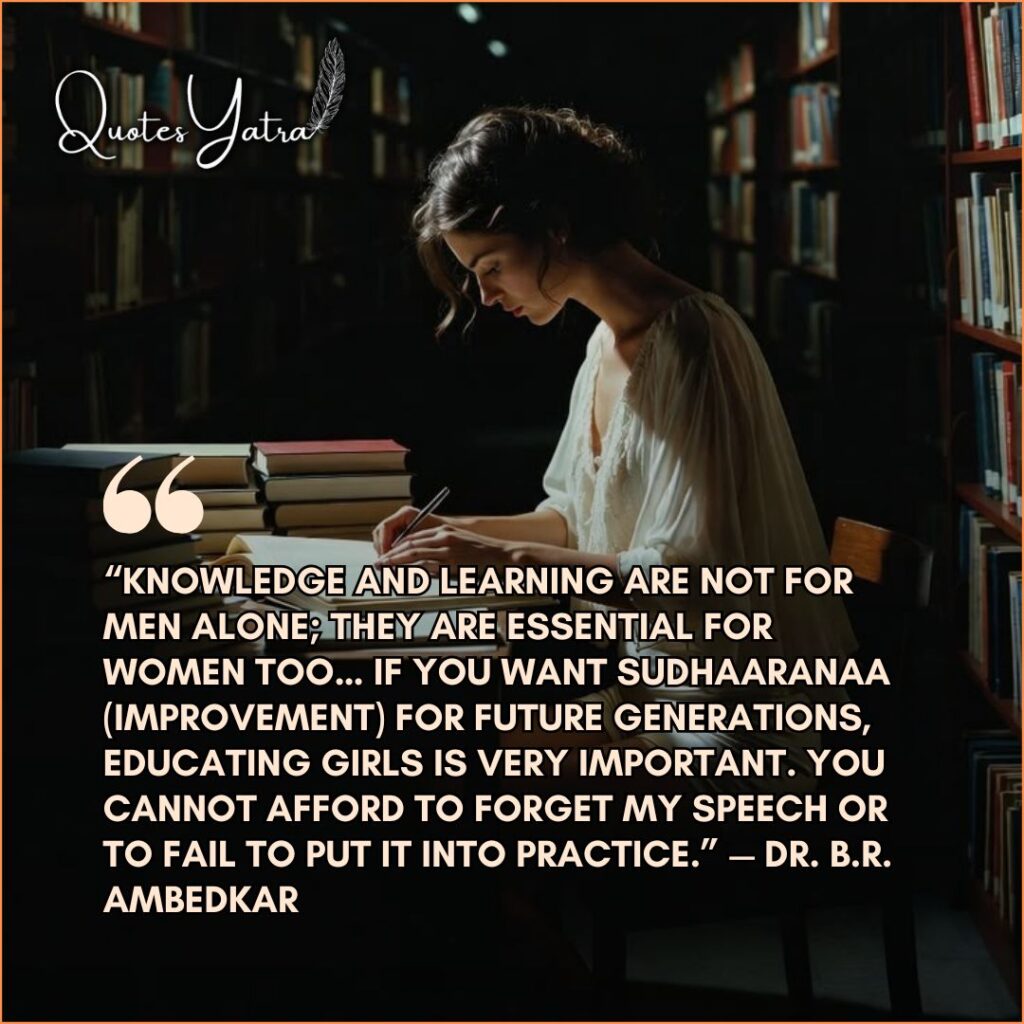
8. “Knowledge and learning are not for men alone; they are essential for women too… if you want sudhaaranaa (improvement) for future generations, educating girls is very important. You cannot afford to forget my speech or to fail to put it into practice.”
- (Source: Verified via Bahishkrut Bharat editorial, February 3, 1928)
- Why it works: This is one of his earliest and most direct statements on female education, published in his own newspaper. He completely rejects the idea of male intellectual monopoly, framing girls’ education not just as a personal right, but as the mathematical prerequisite for a community’s future success.
- Best for: Educational NGO campaigns, scholarship drive promotions, and National Girl Child Day graphics.
9. “The stories of women entering into public discussions with men on most abstruse subjects of religion, philosophy and metaphysics are by no means few… showing that Indian women in pre-Manu’s time could rise to the highest pinnacle of learning and education.”
- (Source: Verified via BAWS Vol. 17, Part 2 / The Rise and Fall of the Hindu Woman, 1950)
- Why it works: This is a masterful piece of historical reclamation. He arms modern women with the knowledge that female intellectualism isn’t a “Western import”—it is an ancient Indian reality. He proves that women historically debated the most complex philosophical subjects as equals with men.
- Best for: University thesis hooks, essays on women in academia, and feminist history discussions.
10. “Never regard yourself as untouchables. Live a clean life and cultivate self-respect. Send your children to schools. Education is necessary for females as it is for males. If you know how to read and write, there would be much progress. As you are, so your children will be.”
- (Source: Verified via BAWS Vol. 17, Part 3 / Speech to Women in Bombay, 1938)
- Why it works: Speaking directly to working-class mothers, he makes literacy a non-negotiable family standard. He brilliantly places the intellectual future of the next generation directly in the hands of mothers, urging them to educate themselves so their children will follow suit.
- Best for: Mother’s Day educational campaigns, adult literacy programs, and community empowerment posts.
11. “I am a great believer in women’s organization. I know what they can do to improve the condition of society if they are convinced. In the eradication of social evils they have rendered great services.”
- (Source: Verified via BAWS Vol. 17, Part 3 / Speech at All-India Depressed Classes Women’s Conference, 1942)
- Why it works: This transitions from individual education to collective intellectual power. He validates that when women organize, share ideas, and build intellectual communities, they become the single most effective force for destroying systemic social evils.
- Best for: Women’s leadership seminars, feminist organization bios, and civic action motivation.
12. “From the Shrauta Sutras it is clear that women could repeat the Mantras of the Vedas and the women were taught to read the Vedas. Panini’s Ashtadhyayi bears testimony to the fact that women attended Gurukul (College) and studied the various Shakhas (Sections) of the Veda and became expert in Mimansa. Patanjali’s Maha Bhashya shows that women were teachers and taught Vedas to girl students.”
- (Source: Verified via BAWS Vol. 17, Part 2 / The Rise and Fall of the Hindu Woman)
- Why it works: This is a heavy-hitting historical fact. He uses ancient grammar texts (Panini) to mathematically prove that female professors and scholars were a normal, accepted part of ancient Indian society before oppressive laws were introduced.
- Best for: University-level feminist research, historical deep-dives, and debunking regressive traditions.
Quotes on Legal Rights & Constitutional Protections
Ambedkar’s words here reflect his revolutionary legal vision, where equality is not symbolic but written into law. These quotes underline how true justice begins when women are granted equal rights in property, marriage, and personal freedom.
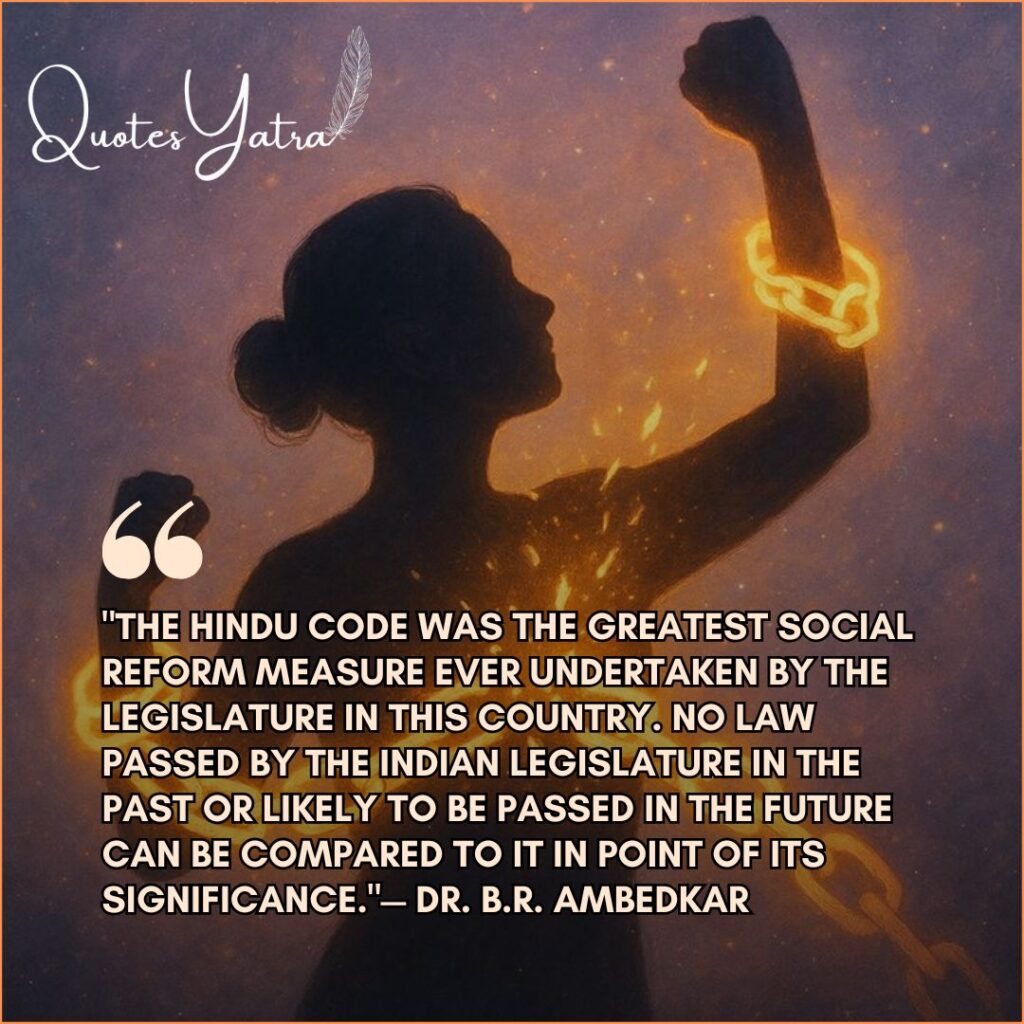
13. “The Hindu Code was the greatest social reform measure ever undertaken by the Legislature in this country. No law passed by the Indian Legislature in the past or likely to be passed in the future can be compared to it in point of its significance.”
- (Source: Verified via BAWS Vol. 14, Part 2 / Statement on Resignation from the Cabinet, 1951)
- Why it works: This is his definitive statement on the importance of women’s legal rights. He boldly declares that the bill designed to give women the right to divorce and inherit property was the single most important piece of legislation in Indian history—even more significant than economic or infrastructure laws.
- Best for: Legal history blogs, Constitution Day features, and essays on legislative feminism.
14. “If you want to maintain the Hindu system, Hindu culture and Hindu society, do not hesitate to repair where repair is necessary. This bill asks for nothing more than to repair those parts of the Hindu system which have become dilapidated.”
- (Source: Verified via Constituent Assembly Debates / Speech on the Hindu Code Bill)
- Why it works: He brilliantly corners conservative politicians by framing women’s legal rights not as a destruction of culture, but as a mandatory “repair” to save the society from collapsing under its own oppressive weight.
- Best for: Political history blogs, essays on cultural reform, and legal advocacy editorials.
15. “The Bill seeks to do away with the inequality between man and woman in the matter of property… It recognizes that a daughter has an equal share in the property of her father along with the son.”
- (Source: Verified via BAWS Vol. 14, Part 1 / Introducing the Hindu Code Bill)
- Why it works: This is his direct, plain-English summary of the legal destruction of the patriarchy, explaining that true constitutional protection requires writing female financial independence directly into property law.
- Best for: Women’s inheritance rights campaigns, financial independence blogs, and legal history posts.
16. “You cannot tie a woman to a man who is a lunatic, who is suffering from an incurable and loathsome disease, or who has deserted her… To deny the right to divorce in such cases is a cruelty which no civilized society can justify.”
- (Source: Verified via BAWS Vol. 14, Part 2 / Speech in Parliament on the Hindu Code Bill)
- Why it works: A fierce, unapologetic defense of legal autonomy. He attacks the romanticized, orthodox view of “unbreakable” marriage, arguing that without a legal escape route, marriage simply becomes a state-sanctioned prison.
- Best for: Divorce rights advocacy, feminist legal critiques, and essays on marital autonomy.
17. “Under the existing law, a woman cannot adopt a child to herself. She can only adopt to her husband… The present Bill makes a departure. It recognizes the independent right of a woman to adopt.”
- (Source: Verified via BAWS Vol. 14, Part 1 / Debates on the Hindu Code Bill)
- Why it works: This highlights a massive, often overlooked legal victory by shifting the legal definition of motherhood from an act done on behalf of a man’s lineage to an independent, constitutional right held by the woman herself.
- Best for: Single motherhood advocacy, adoption agency campaigns, and women’s legal rights forums.
18. “If monogamy is good, then I want it for the Hindus whether it is applied to anybody else or not… I do not want to argue that if the rule of monogamy is good for the Hindus it should not come to them unless it comes for everybody else.”
- (Source: Verified via BAWS Vol. 14, Part 2 / Hindu Code Bill Clause-by-Clause Discussion)
- Why it works: This directly addresses his defense of monogamy in the Hindu Code Bill. He argued that legal protections for women shouldn’t be delayed simply because other communities haven’t adopted them simultaneously.
- Best for: Constitutional law discussions, Uniform Civil Code debates, and feminist legal history.
19. “Any marriage, solemnized whether before or after the commencement of this Code, may be annulled by a decree of divorce on any of the following grounds namely:— (i) either party to the marriage was impotent at the time of the marriage and continued to be so until the institution of the proceeding; (ii) the husband is keeping a * * * concubine or the wife has become the concubine of any other man or leads the life of a prostitute; (iii) either party to the marriage has ceased to be a Hindu by conversion to another religion; (iv) either party is incurably of unsound mind and has been continuously under treatment for a period of not less than five years preceding the petition; and (v) either party is suffering from a virulent * * * form of leprosy..”
- (Source: Verified via BAWS Vol. 14, Part 1 / Writings and Speeches)
- Why it works: Rather than a rhetorical speech, this is the actual text of the drafted law he submitted. It represents his tactical move to provide women a legally defined exit strategy from marriages under extreme circumstances, breaking the orthodox view that a marriage could never be dissolved.
- Best for: Legal history archives, academic analyses of the Hindu Code Bill, and foundational divorce law discussions.
Quotes on Caste, Social Custom & the Oppression of Women
This section reveals the deep connection between caste systems and the control of women’s lives. Through sharp analysis, these quotes expose how oppressive customs were designed to maintain social hierarchies at the cost of women’s freedom.
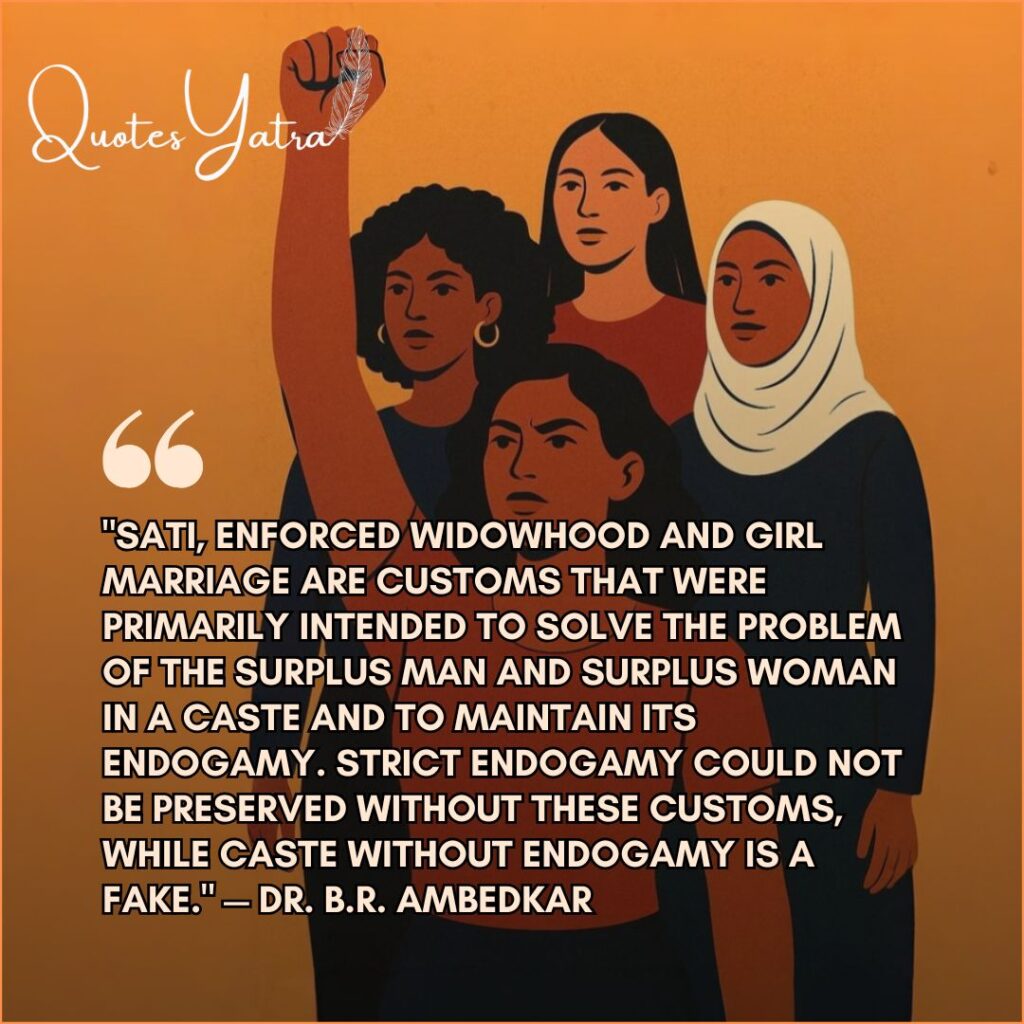
20. “Sati, enforced widowhood and girl marriage are customs that were primarily intended to solve the problem of the surplus man and surplus woman in a caste and to maintain its endogamy. Strict endogamy could not be preserved without these customs, while caste without endogamy is a fake.”
- (Source: Verified via BAWS Vol. 1 / Castes in India: Their Mechanism, Genesis and Development, 1916)
- Why it works: A devastating exposure of a cruel social custom. He argues that if a woman’s husband died, she became a “surplus” woman who might marry outside the caste and ruin their bloodline purity. To prevent this, orthodox society invented the custom of enforced widowhood, stripping her of rights purely to protect the caste structure.
- Best for: Sociological essays, caste critique blogs, and feminist history articles.
21. “The problem of Caste, then, ultimately resolves itself into one of repairing the disparity between the marriageable units of the two sexes within it… Thus both the surplus man and the surplus woman constitute a menace to the Caste if not taken care of, for… very likely they will transgress the boundary, marry outside and import offspring that is foreign to the Caste.”
- (Source: Verified via BAWS Vol. 1 / Castes in India: Their Mechanism, Genesis and Development, 1916)
- Why it works: This is the foundational quote linking the oppression of women to the survival of the caste system. He scientifically explains that “endogamy” (forcing people to marry only within their group) is what created caste. To enforce this, society had to heavily control and oppress women’s choices, proving that caste and patriarchy are the exact same machine.
- Best for: Deep-dive sociological research, intersectional feminist essays, and university anthropology hooks.
22. “It will now be seen that the four means by which numerical disparity between the two sexes is conveniently maintained are: (1) burning the widow with her deceased husband; (2) compulsory widowhood—a milder form of burning; (3) imposing celibacy on the widower; and (4) wedding him to a girl not yet marriageable. Though, as I said above, burning the widow and imposing celibacy on the widower are of doubtful service to the group in its endeavour to preserve its endogamy, all of them operate as means. But means, as forces, when liberated or set in motion create an end. What then is the end that these means create? They create and perpetuate endogamy, while caste and endogamy, according to our analysis of the various definitions of caste, are one and the same thing. Thus the existence of these means is identical with caste and caste involves these means.”
- (Source: Verified via BAWS Vol. 1 / Castes in India: Their Mechanism, Genesis and Development, 1916)
- Why it works: This is his brutal, academic breakdown of how the patriarchy engineered violent social customs purely to keep the caste system biologically intact. He scientifically frames “Sati” and child marriage not as spiritual traditions, but as cold, calculated demographic control over women’s bodies.
- Best for: Academic history posts, deep-dives on the origins of patriarchy, and demographic control essays.
23. “Fusion of blood can alone create the feeling of being kith and kin, and unless this feeling of kinship, of being kindred, becomes paramount, the separatist feeling—the feeling of being aliens—created by Caste will not vanish.”
- (Source: Verified via BAWS Vol. 1 / Annihilation of Caste, 1936)
- Why it works: Following his earlier point on inter-marriage, this quote explains why the social custom of endogamy (restricted marriage) is so destructive. By forbidding women from marrying freely across community lines, the caste system ensures that society remains permanently divided.
- Best for: Inter-caste marriage advocacy, social unity editorials, and anti-caste movement blogs.
24. “Manu was the greatest opponent of the Buddhist religion. This is the secret of the many inequities which he heaped upon women. For he knew that if the home is to be protected against the invasion of Buddhism it is the woman who must be put under restraint.”
- (Source: Verified via BAWS Vol. 3 / The Woman and the Counter-Revolution)
- Why it works: This is a spectacular historical insight. He explains that the brutal social customs inflicted on women were not random; they were a calculated political strategy. Orthodox lawmakers deliberately suppressed women’s freedom to prevent them from adopting progressive, egalitarian religions that threatened the caste hierarchy.
- Best for: Religious history critiques, political strategy essays, and comparative religion discussions.
25. “You will ask me how to make your living. I am not going to tell you that. There are hundreds of ways of doing it. But I insist that you give up this degraded life…. and do not live under conditions which inevitable drag you into prostitution..”
- (Source: Verified via Address to the Devadasis and Prostitutes of Kamathipura, Bombay, June 16, 1936)
- Why it works: This attacks the ultimate oppressive social custom: the Devadasi system. He bluntly shuts down the religious justification for forcing lower-caste women into sex work, telling them to break the custom immediately, regardless of the economic uncertainty, because their dignity is paramount.
- Best for: Anti-exploitation campaigns, sex workers’ rights history, and human dignity editorials.
26. “By admitting women to the life of Parivrajika, the Buddha, by one stroke, removed both these wrongs. He gave them the right to knowledge and the right to realize their spiritual potentialities along with man. It was both a revolution and liberation of women in India.”
- (Source: Verified via BAWS Vol. 17, Part 2 / The Rise and Fall of the Hindu Woman, 1950)
- Why it works: This highlights a radical historical break from orthodox social custom. He proves that liberating women from oppressive religious customs—specifically the custom that forbade them from independent spiritual or intellectual pursuits—is the foundational step in breaking the patriarchy.
- Best for: Buddhist history blogs, spiritual equality campaigns, and essays on women’s liberation.
Quotes on Economic Independence & Labor Rights for Women
Ambedkar highlights that without economic independence, equality remains incomplete. These quotes stress fair wages, maternity rights, and workplace dignity as essential pillars of real empowerment.
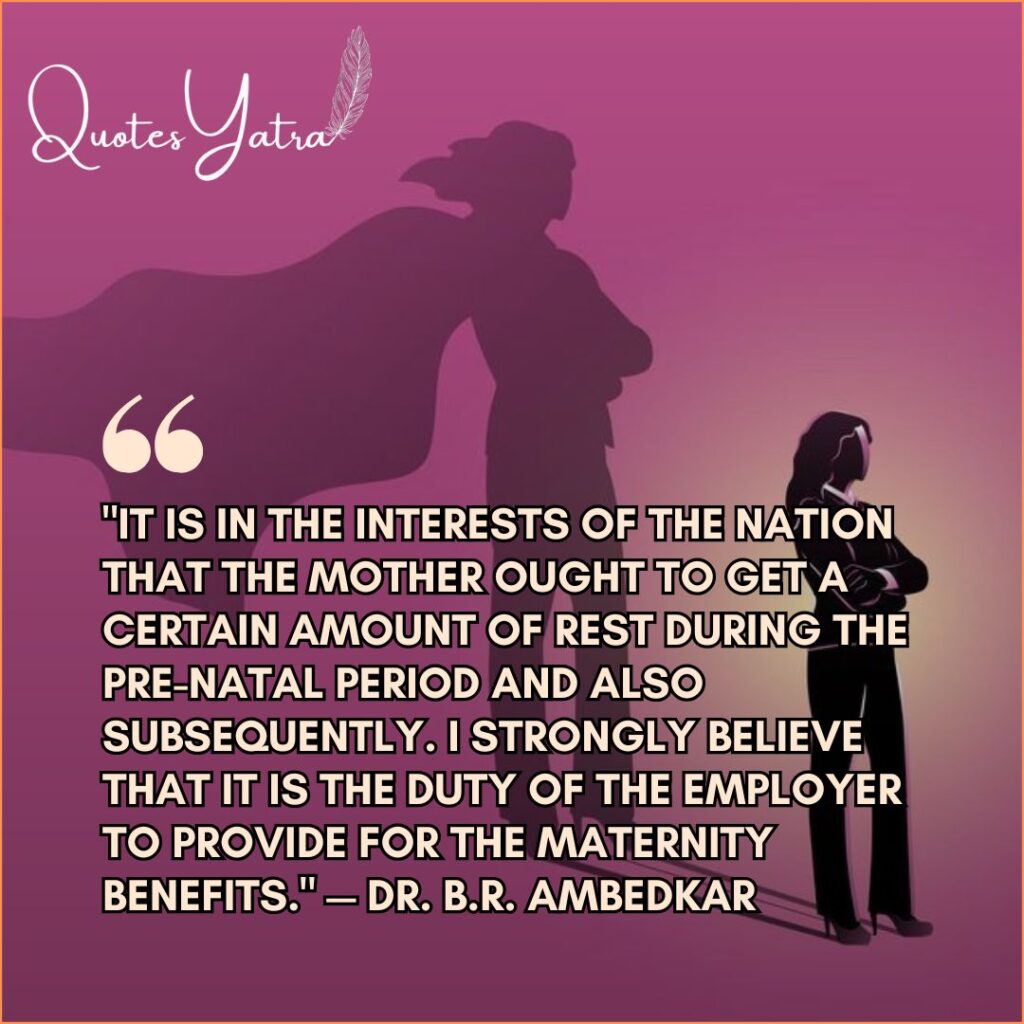
27. “It is in the interests of the nation that the mother ought to get a certain amount of rest during the pre-natal period and also subsequently. I strongly believe that it is the duty of the employer to provide for the maternity benefits.”
- (Source: Verified via BAWS Vol. 2 / Bombay Legislative Council Debates on the Maternity Benefit Bill, July 1928)
- Why it works: This is a spectacular piece of labor history. Long before modern corporate maternity leave existed, he was fighting in the legislature to legally force employers to pay women during their pregnancies, arguing that maternal health is a national economic priority.
- Best for: Corporate HR policy discussions, working mothers’ support networks, and Labor Day features.
28. “I am therefore fundamentally opposed to the principle… that the burden of this maternity benefit should be borne by the State… the employer pays for the upkeep of the horse, but he does not pay for the upkeep of the human machine.”
- (Source: Verified via BAWS Vol. 2 / Bombay Legislative Council Debates, 1928)
- Why it works: A fierce, unapologetic defense of female factory workers. He shut down capitalists who wanted the government to pay for maternity leave, famously comparing workers to machines and demanding that the corporations profiting off female labor must pay for their health and rest.
- Best for: Union organizing materials, workers’ rights campaigns, and economic justice quotes.
29. “To leave untouched the inequality between class and class, between sex and sex… and to go on passing legislation relating to economic problems is to make a farce of our Constitution.”
- (Source: Verified via BAWS Vol. 14, Part 2 / Statement on Resignation from the Cabinet)
- Why it works: He brilliantly links macro-economics directly to gender equality. He warns the legislature that it is mathematically impossible to solve a country’s economic problems while ignoring the legal and social suppression of half its workforce.
- Best for: Macro-economic policy discussions, constitutional law essays, and gender pay gap awareness campaigns.
30. “There is nothing wrong in being grateful to great men who have rendered life-long services to the country. But there are limits to gratefulness… Bhakti in religion may be a road to the salvation of the soul. But in politics, Bhakti or hero-worship is a sure road to degradation and to eventual dictatorship.”
- (Source: Verified via BAWS Vol. 13, p. 1215 / Constituent Assembly Debates, November 25, 1949)
- Why it works: This is arguably his most famous and prescient warning. It draws a brilliant contrast between spiritual devotion and political accountability, warning citizens never to lay their liberties at the feet of a “great man.”
- Best for: Op-eds on political cults of personality, youth voter awareness campaigns, and Twitter/X threads on democratic accountability.
31. “I feel that the constitution is workable, it is flexible and it is strong enough to hold the country together both in peacetime and in wartime. Indeed, if I may say so, if things go wrong under the new Constitution, the reason will not be that we had a bad Constitution. What we will have to say is, that Man was vile.”
- (Source: Verified via BAWS Vol. 13, p. 62 / Constituent Assembly Debates, November 4, 1948)
- Why it works: It places the ultimate responsibility for a nation’s success or failure squarely on the shoulders of its citizens and politicians, not on the legal document itself. It is the ultimate quote on civic responsibility.
- Best for: Law school graduation speeches, legal blogs, and Constitution Day (Samvidhan Diwas) tributes.
32. “There is no doubt that an employer employs women in certain industries because he finds that there is a greater profit to be gained by him by the employment of women than he would gain by the employment of men. He is able to get pro rata larger benefits out of women than he would get by employing men. That being so, it is absolutely reasonable to say that to a certain extent at least the employer will be liable for this kind of benefit when he gets a special benefit by employing women instead of men”
- (Source: Verified via BAWS Vol. 2 / Bombay Legislative Council Debates on the Maternity Benefit Bill, July 28, 1928)
- Why it works: He strips away corporate excuses by stating a simple capitalist fact: companies hire women because they make a mathematically higher profit off their labor. Therefore, forcing companies to fund maternity leave is not a charity, but a justified corporate liability.
- Best for: Corporate accountability discussions, labor rights editorials, and working mothers’ advocacy.
33. “We have also taken care to see, and this is an important point, that women shall be paid the same wages as men. It is for the first time that I think in any industry the principle has been established of equal pay for equal work irrespective of the sex.”
- (Source: Verified via Speeches as Labour Member of the Viceroy’s Executive Council, 1943)
- Why it works: This is a monumental piece of labor history. Speaking on reforms for female mine workers, he explicitly celebrates the legal destruction of the gender pay gap, proving his direct role in establishing the fundamental economic right to equal wages.
- Best for: Equal Pay Day posts, labor union history, and women in the workplace motivation.
QuotesYatra Originals: Ambedkar’s Vision for Indian Women
Inspired by Ambedkar’s philosophy, these reflections reimagine his vision in a modern voice. They focus on independence, courage, and the ongoing journey of women breaking barriers across generations.
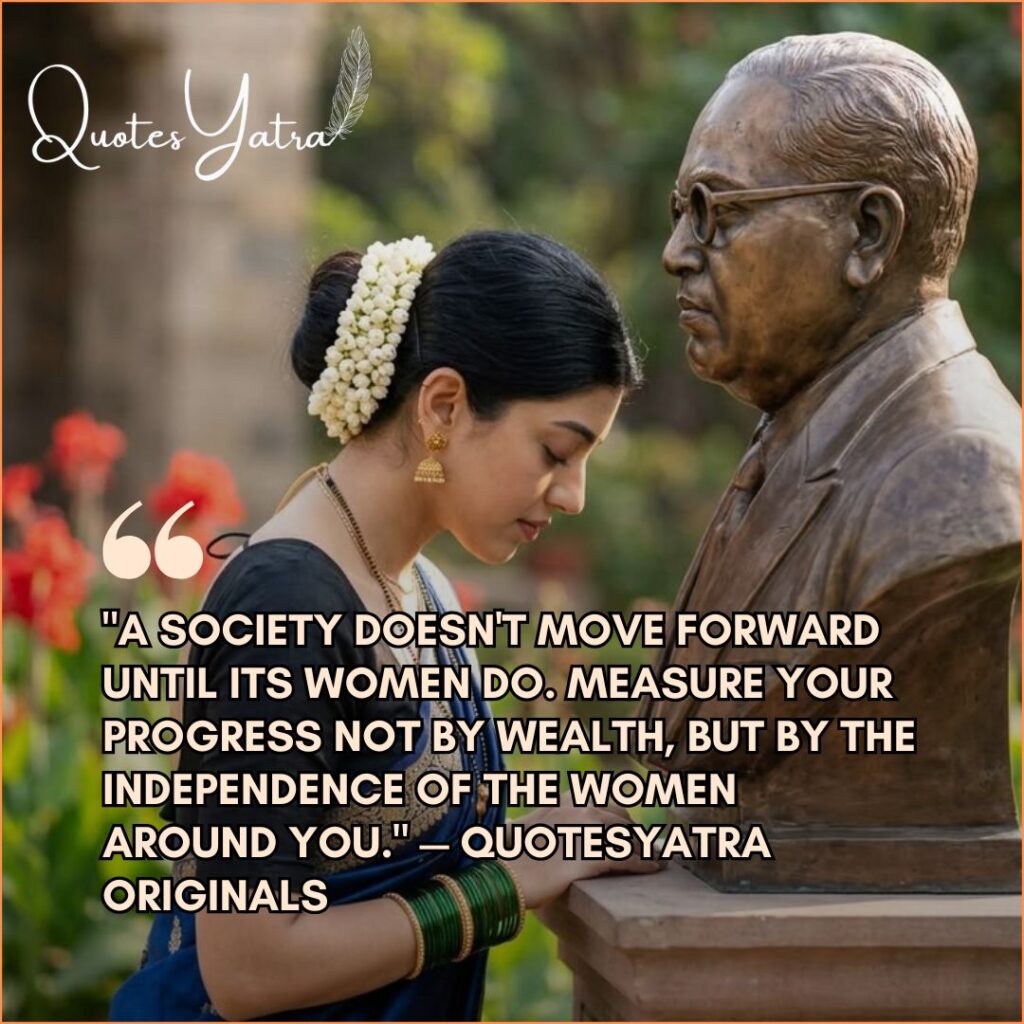
- The True Measure of Progress “A society doesn’t move forward until its women do. Measure your progress not by wealth, but by the independence of the women around you.” — QuotesYatra Originals
- Best for: International Women’s Day posts, feminist typography graphics, and short WhatsApp statuses.
- The Partnership Mandate “Refuse to be anything less than an equal. True partnership is built on mutual respect, not submission.” — QuotesYatra Originals
- Best for: Modern wedding captions, relationship advice blogs, and aesthetic Instagram stories.
- The Foundation of Independence “Education is your greatest asset and financial independence is your loudest voice. Never let society rush you into sacrificing either.” — QuotesYatra Originals
- Best for: Graduation posts, career motivation for young women, and Monday morning inspiration.
- Breaking the Illusion “Economic growth means nothing if social equality is left behind. You cannot build a modern future on traditional prejudices.” — QuotesYatra Originals
- Best for: Social justice editorials, critical Twitter/X threads, and thought-provoking carousel covers.
- The Right to Autonomy “Your life, your ambition, your choices. Empowerment starts the moment you stop asking for permission to be equal.” — QuotesYatra Originals
- Best for: Fierce selfie captions, daily affirmations, and minimalist social media graphics.
- The Courage to Rewrite “True empowerment isn’t just surviving the system; it is having the courage to rewrite the rules entirely. Never apologize for demanding your space at the table.” — QuotesYatra Originals
- Best for: Bold typographic posters, Monday motivation posts, and fierce social media bios.
- The Generational Shift “When you educate a woman, you don’t just change her life—you break the chains for every generation that follows. Her independence is the ultimate rebellion.” — QuotesYatra Originals
- Best for: Educational NGO features, Mother’s Day campaigns with a progressive edge, and deep-dive carousel conclusions.
Frequently Asked Questions: Verifying Dr. Ambedkar’s Quotes
Yes. The internet is flooded with paraphrased, altered, or entirely fabricated sayings attributed to historical figures. QuotesYatra has a strict zero-paraphrasing policy. Every single quote in this collection has been rigorously verified word-for-word against primary historical archives, specifically the Dr. Babasaheb Ambedkar Writings and Speeches (BAWS) volumes.
These statements are pulled directly from his original academic essays, parliamentary speeches, and editorials. The primary sources include his monumental text The Rise and Fall of the Hindu Woman, his writings on the Hindu Code Bill during the Constituent Assembly Debates, and foundational sociological papers like Castes in India.
Absolutely. Because QuotesYatra provides the exact original text alongside the specific source document and volume (e.g., BAWS Vol. 17, Part 2), students, researchers, and journalists can safely cite these quotes in academic papers, sociology essays, and official publications without fear of using a fabricated internet saying.
If a popular quote attributed to Dr. Ambedkar is missing from our list, it is highly likely because it could not be historically authenticated. We do not publish “inspirational” quotes that were invented by social media. If it cannot be traced back to his actual speeches or pen, it does not make it onto QuotesYatra.
Historically, his statements defending the Hindu Code Bill are his most legally significant. When resigning over the stalling of the bill—which was designed to give women the right to divorce and inherit property—he famously declared it “the greatest social reform measure ever undertaken by the Legislature in this country.”
Conclusion: The Enduring Legacy of Dr. Ambedkar’s Feminist Vision
Dr. B.R. Ambedkar’s fight for women’s liberation was not a secondary aspect of his political career—it was the very foundation of his vision for a modern, democratic society. As these historically verified texts prove, he understood that you cannot dismantle the caste system, build a thriving economy, or establish true democracy without first destroying the patriarchal laws and social customs that subjugate women.
From demanding equal pay and maternity rights in the 1920s to systematically rewriting the legal codes of marriage, divorce, and property inheritance in the 1950s, his words remain a radical blueprint for equality. He didn’t just advocate for women to be “protected”; he demanded that they be fiercely independent, highly educated, and intellectually liberated.
As you reflect on these Dr. B.R. Ambedkar quotes on women’s rights and social equality, which one resonated with you the most? Share this collection to keep Babasaheb’s true, unfiltered history alive, and bookmark QuotesYatra for the most rigorously verified quote collections on the internet.
Related Reads You’ll Love
If these powerful insights inspired you, here are more thoughtfully curated collections to deepen your understanding, spark motivation, and celebrate meaningful moments of life:
- 60 Rare & Verified Dr. B.R. Ambedkar Quotes on Education, Equality & Democracy from His Original Writings (2026)
- Explore lesser-known yet deeply impactful words that reveal Ambedkar’s intellectual brilliance and his vision for a just and educated society.
- 35+ Life-Changing Dr. B.R. Ambedkar Quotes for Students & Youth on Education, Equality & Leadership (2026)
- A perfect read for students and young minds seeking direction, confidence, and purpose through Ambedkar’s timeless wisdom.
- 80+ Dr. B.R. Ambedkar Jayanti Quotes, Wishes & Captions to Celebrate Equality, Justice and Inspiration (2026)
- Celebrate Ambedkar Jayanti with meaningful quotes, heartfelt wishes, and powerful captions that honor his enduring legacy.
- 130+ Best April Quotes: Changing Seasons, Spring, Rain, Birthdays & April Fools (2026)
- Step into the beauty of April with quotes that capture new beginnings, refreshing rains, joyful birthdays, and light-hearted moments.
Let these collections continue to inspire your journey, one meaningful quote at a time.